Will AI Job Applications Get Me Caught? What Recruiters Actually See
Quick verdict
You are mostly worried about the wrong thing. Almost no recruiter runs your resume through an AI detector, and even when they check a cover letter, the detectors guess more than they know. What actually gets you passed over is not "this was written by AI." It is "this sounds exactly like the other 300 AI cover letters I read this week." The risk is being generic, not being caught.
What recruiters and their software actually see
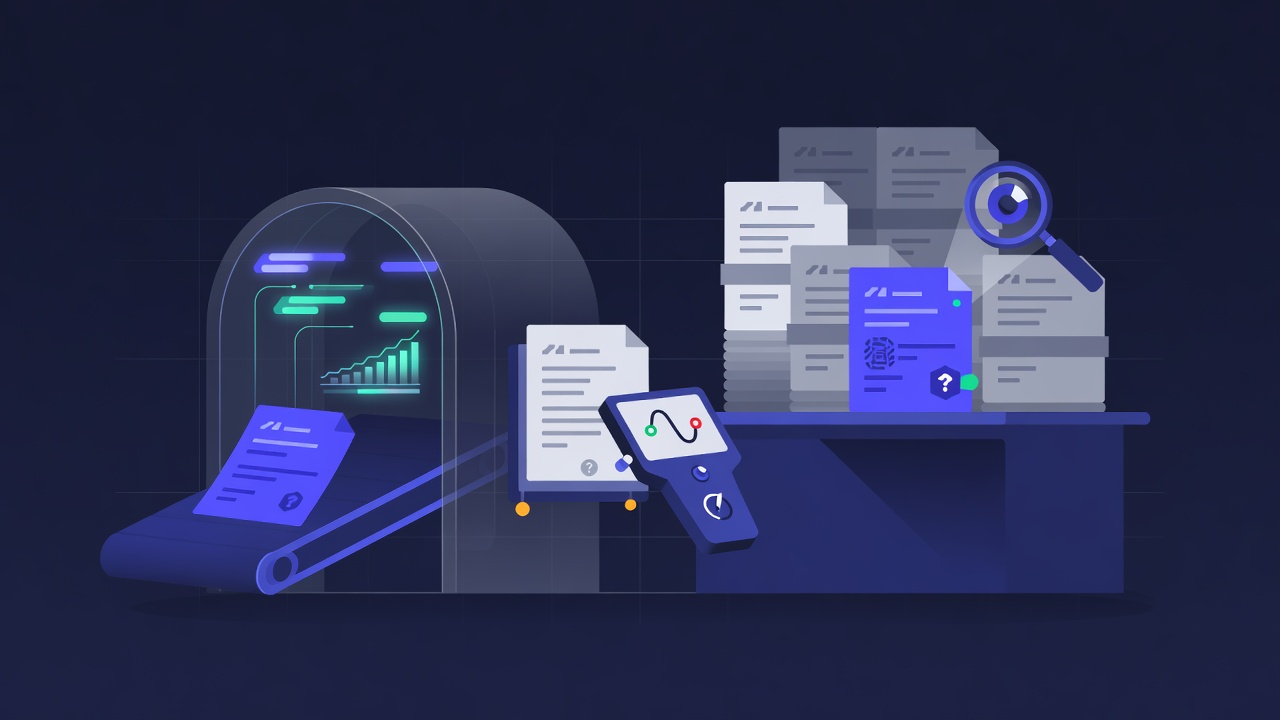
Your application hits two audiences: a piece of software first, then a human if you clear it. The software is an applicant tracking system, and it is nearly everywhere. Jobscan's 2025 analysis found a detectable ATS at 97.8% of Fortune 500 companies, roughly 489 of them. That system parses your resume into fields, pulls out keywords, and ranks you against the job description. In the same report, 76.4% of recruiters said they search and rank candidates by the skills listed in the posting.
Here is the part that matters: the ATS is a sorting machine, not an AI-writing detector. It is looking for whether your experience matches the role, not whether a language model helped you phrase it. If a human recruiter opens your file, they see your resume and, sometimes, your cover letter. That is the whole surface. There is no hidden "written with AI" flag riding along with your PDF.
Can they actually prove you used AI?
No, and the tools that claim to are shaky. Resumes are the hardest thing in the world to run detection on. They are bullet fragments, keywords, and dates, with almost none of the flowing sentences a detector needs to make a call, so detectors basically shrug at them. Cover letters are more exposed because they are real paragraphs, and services like Originality.AI market detection aimed right at them. The catch is that these detectors produce false positives on plenty of human writing too, so a smart recruiter treats a detector score as a rumor, not evidence.
That does not mean nobody notices. Recruiters read hundreds of these. They clock the tells by feel: the same polished opening, the "I am excited to leverage my skills" filler, the paragraph that praises the company using words straight off the homepage. They cannot prove a machine wrote it. They do not need to. They just move on to the candidate who sounds like a person.
The real reason AI applications get rejected
The surge is real, and it is annoying the people on the other side. A Robert Half survey of more than 2,000 hiring managers, run in late 2025, found 67% said reviewing AI-generated applications had slowed their hiring, and 65% said the flood made it harder to tell whether a candidate's skills were genuine. When reviewers are already suspicious of a wall of identical applications, blending into that wall is the failure mode. Standing out is the goal, and default AI output is the opposite of standing out.
So the thing to avoid is not AI. It is the fingerprint of lazy AI: no specific details, no numbers from your actual work, enthusiasm that would fit any company on earth. A recruiter forgets that in four seconds.
How to use AI without sounding like everyone else
Used well, AI is a research and drafting assistant, not a ghostwriter you copy blindly. A few habits keep you on the safe side of the line:
- Feed it your real material. Paste your actual accomplishments, metrics, and the specific job description, then ask it to draft from those. Generic in, generic out.
- Rewrite the opening line yourself. The first sentence is where AI tells cluster hardest, so make that one unmistakably yours.
- Cut the praise paragraph. If a sentence about the company could be pasted into an application for their competitor, delete it.
- Read it out loud before sending. If it sounds like a press release, it will read like one.
This is also where running more than one model helps. Different models phrase things differently, so drafting in one and tightening in another gets you further from the default voice than hammering a single tool. That is part of the case for reaching several models from one app instead of a single chatbot, and for the general habit of using AI as a drafting partner rather than an autopilot.
Video: how recruiters spot AI on a resume
A recruiter's-eye view of the tells that make AI writing obvious, and what to change.
FAQ
Do companies run AI detectors on resumes?
Almost never on resumes, since there is not enough prose for a detector to judge. Some do run them on cover letters or writing samples, but the results are unreliable and rarely used as a hard reject on their own.
Will an ATS reject my application because it looks AI-written?
No. An ATS sorts and ranks by keywords and skills match, not by writing origin. It is checking whether you fit the role, not whether a model helped you write.
Is it safe to use AI for cover letters at all?
Yes, if you edit. The danger is submitting untouched output that sounds like every other AI letter. Draft with AI, then load it with specifics only you could write, and rewrite the opening in your own voice.
Sources
- Jobscan - 2025 ATS usage: 97.8% of Fortune 500 use an ATS; 76.4% of recruiters rank by skills
- Hiration - Robert Half survey: 67% of hiring managers say AI applications slowed hiring, 65% struggle to verify real skills
- Originality.AI - on detecting AI in cover letters (and its limits)
- Paper Checker - how recruiters actually use AI detection on applications
Further reading
Try all the models mentioned in this article
Admix gives you GPT-5, Claude, Gemini, and 350+ AI models in one app. Compare responses side by side. Free to start.
Start free on Admix