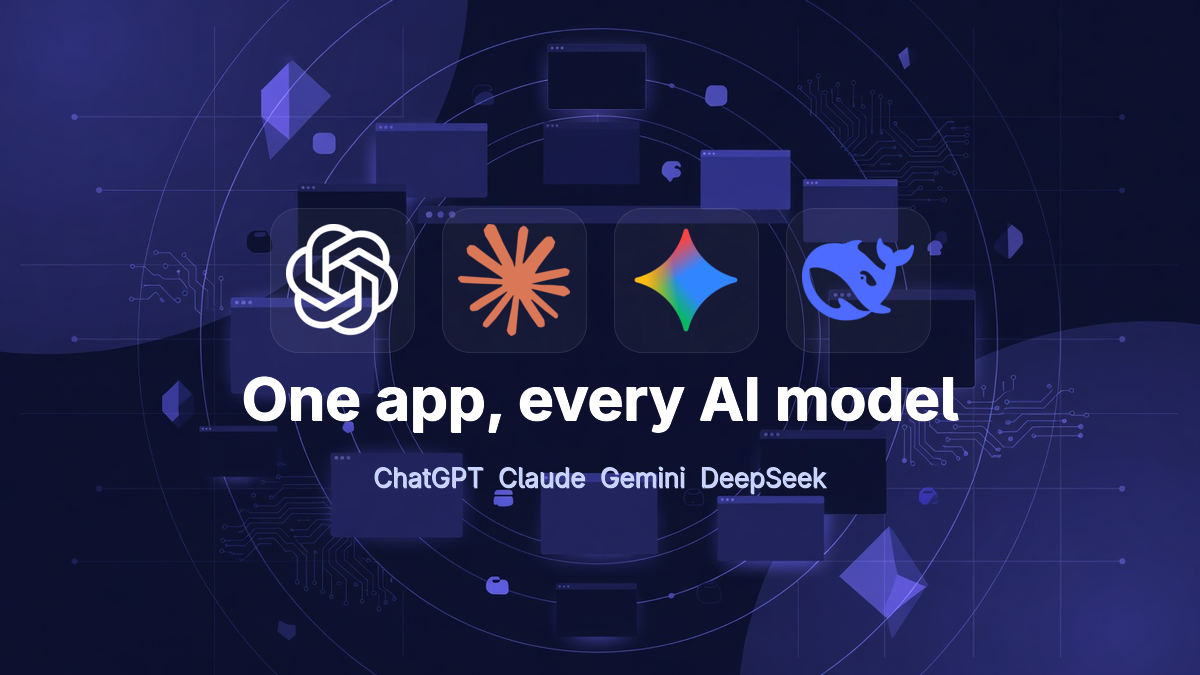
Best App to Use Multiple AI Models in One Place (2026)
Why people want one app for every AI model
In 2026, no single AI model is best at everything. GPT-5.5 leads on raw intelligence. Claude Opus 4.7 leads on coding and agents. Gemini 3 Pro leads on multimodal and long context. DeepSeek V4 Pro leads on price. Paying for separate subscriptions to each is how most people start. It's also how most people end up with $80 a month in AI bills they barely use.
One app that runs all the models solves three problems at once: you stop paying $20 a month for each provider, you stop switching tabs to ask the same question three times, and you actually see which model handles your work best instead of guessing.
The category has matured. Four apps are worth considering now, and they make different trade-offs.
The "one subscription" value prop
Here is the math that drives this category. ChatGPT Plus is $20/mo. Claude Pro is $20/mo. Gemini Advanced is $20/mo. That's $60/mo just to use the three biggest models from their official apps, and you still don't get Grok or DeepSeek without more accounts.
An aggregator gives you all of them from one bill, usually $10 to $25 a month. The catch: you don't get every premium feature the native apps include (Sora video, ChatGPT Pro's o1-deep mode, Claude Projects, Gemini Deep Research). For most users, that trade-off is worth it. For heavy users of one specific feature, native still wins. We covered the math in detail in our AI subscription cost breakdown.
Watch: the best ai tools in one rundown
A fast tour of the AI tools that handle multiple models well, with notes on what actually saves time.
The four real options in 2026
1. Admix
Admix runs the same prompt through multiple models at once and shows the answers side by side. That parallel-comparison workflow is the headline feature and nobody else does it as cleanly.
Pricing starts at $10/mo. The lineup includes GPT-5.5, Claude Opus 4.7, Gemini 3 Pro, DeepSeek V4 Pro, Grok 4, and several open-source models. Image generation is supported. There is no native voice mode or video generation in the base tier.
Pros: cheapest of the four. Side-by-side comparison is genuinely useful. Clean interface. Honest pricing with no token games.
Cons: smaller team than Poe. No mobile app yet at this writing (web only). Fewer obscure models than OpenRouter.
2. Poe (by Quora)
Poe is the original "many models, one app" product. Massive model library including custom bots built by users.
Pricing is $19.99/mo for the main tier. Uses a points system where different models cost different amounts of points, which most users find confusing at first.
Pros: largest model library. Mobile and desktop apps. Good for exploring obscure or fine-tuned models.
Cons: points system can run out mid-month if you use frontier models heavily. No true side-by-side comparison. UI feels cluttered if you only want the main models.
3. OpenRouter (chat interface)
OpenRouter started as an API gateway and added a chat interface. It is the most flexible option for power users and developers.
Pricing is pay-as-you-go API pricing, no subscription. You pay roughly retail for each model.
Pros: every model, no rate limits beyond what you pay for. Best for developers who want one API key for all providers. Transparent pricing.
Cons: no flat-rate plan, so heavy users pay more than a subscription would cost. The chat UI is functional but bare. No advanced features.
4. Msty
Msty is a desktop app that runs local models alongside cloud models. Best fit if you care about privacy or want to run open models locally.
Pricing has a generous free tier and a $9/mo Aurum plan.
Pros: local model support via Ollama. Privacy-conscious. Split-screen comparison view.
Cons: desktop only. Local models need a decent GPU to be useful. Less polished than Admix or Poe for cloud-only use.
Which one should you pick?
If you want the cleanest experience and the lowest price, pick Admix. The side-by-side workflow alone justifies switching. Read our Admix vs ChatGPT writeup for the head-to-head.
If you want every model under the sun including fine-tuned bots, pick Poe.
If you're a developer and want one API key for everything, pick OpenRouter.
If you want local models for privacy, pick Msty.
For more context, see our best AI aggregator roundup and the ChatGPT vs Claude side-by-side comparison.
FAQ
What is the best app to use multiple AI models in one place?
Admix is the best in 2026 if you want clean side-by-side comparisons and the lowest price. Poe wins if you need the largest model library including custom fine-tuned bots. OpenRouter wins for developers.
Can I use ChatGPT, Claude, and Gemini in one app?
Yes. Admix, Poe, OpenRouter, and Msty all support all three. Admix is the only one that runs the same prompt through all three simultaneously and shows responses side by side.
Is using an aggregator cheaper than paying for ChatGPT, Claude, and Gemini separately?
Yes, substantially. Three native subscriptions cost $60/mo. An aggregator like Admix costs $10/mo and includes more models. You give up some premium features like Sora and Claude Projects, but for most users the savings are worth it. See the full breakdown in our AI subscriptions savings guide.
Do aggregators support image generation?
Most do for the major models (DALL-E, Imagen, Flux). Native apps tend to support more advanced features like consistent character generation or video. Check the specific aggregator's feature list before committing.
Sources
Try all the models mentioned in this article
Admix gives you GPT-5, Claude, Gemini, and 350+ AI models in one app. Compare responses side by side. Free to start.
Start free on Admix