Can AI Really Apply to Jobs for You? (What Actually Happens)
Quick verdict
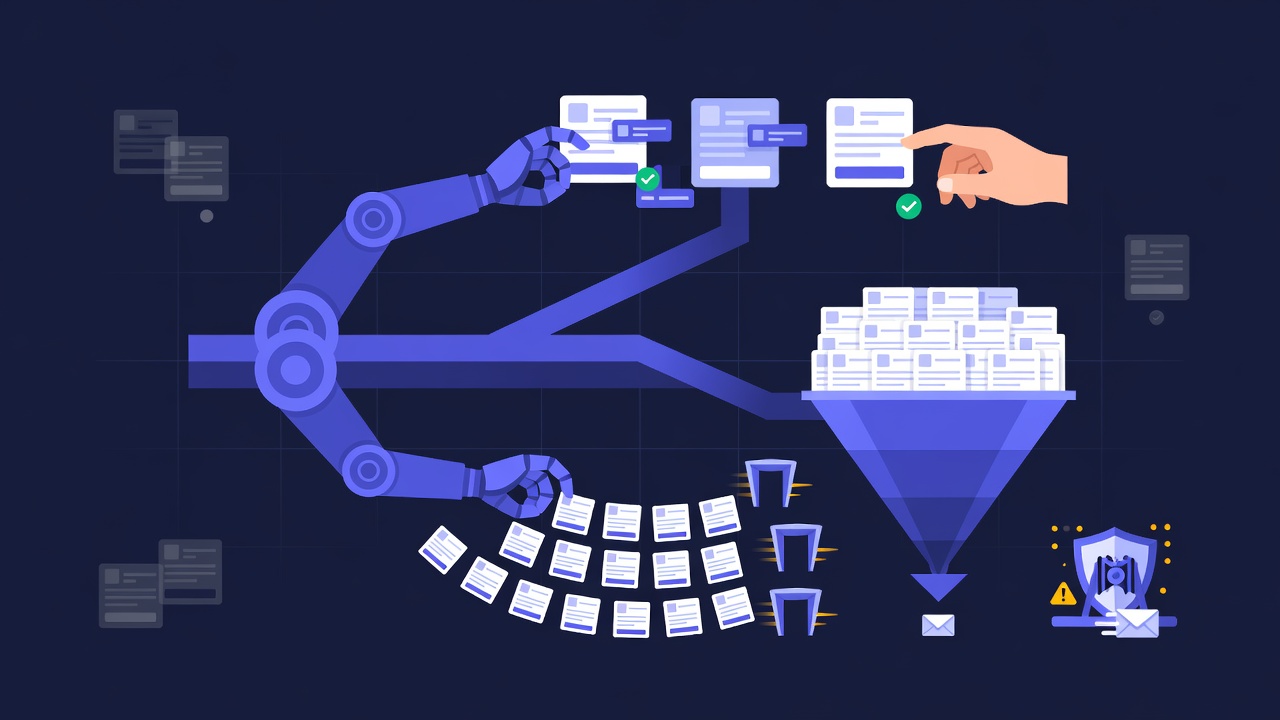
Yes, AI can apply to jobs for you, and it splits into two very different things. Most tools autofill the form and leave you to hit submit. A smaller set actually submits on their own, firing off dozens or hundreds of applications while you do something else. The first kind saves real time. The second kind mostly trades quality for volume, and the numbers on that trade are not flattering.
The two things "AI apply" can mean
When a tool says it applies for you, it is doing one of two jobs, and the gap between them is the whole story.
Autofill assistants read a job form and populate it from your saved profile: name, work history, the endless "describe a time when" boxes. You still see each application before it goes out. Simplify's Copilot is the well-known version of this. You stay in the driver's seat, so nothing embarrassing gets sent without your eyes on it.
Hands-off appliers remove you from the loop. Tools like LazyApply will one-click the same resume across LinkedIn, Indeed, and ZipRecruiter with no tailoring per job. You set filters, walk away, and come back to a submitted-applications counter. There are also open-source versions on GitHub that automate the LinkedIn Easy Apply flow directly. This is the category people mean when they picture a bot job-hunting for them overnight.
What actually happens when a bot applies
The volume is staggering, and you are not the only one doing it. LinkedIn has reported roughly 11,000 job applications submitted every minute on its platform, a 45% jump in a year, with generative AI named as a big reason for the surge. So the hands-off approach drops your application into a pile that is growing faster than anyone can read it.
The response math tells the rest. A bot firing off around 500 applications and getting a single callback is a common story. That is not a rounding error, it is the normal outcome of untargeted mass applying: the same resume, no tailoring, sprayed at everything. You get the satisfying counter and almost none of the interviews.
There is a mechanical catch too. Plenty of tools that advertise "auto-apply" only autofill and never actually submit, because the final step often needs a human click or trips anti-bot checks. So "applied to 1,000 jobs" sometimes means "filled out 1,000 forms," which is a different claim.
Where it quietly backfires
Speed has a bill attached. LinkedIn's terms allow the Easy Apply flow but not applying at inhuman rates, and accounts that blast applications faster than a person could can get throttled or soft-banned, which quietly tanks how often you show up in searches. Careful tools cap themselves at roughly 100 to 150 applications a day and add realistic delays for exactly this reason.
The bigger cost is on the receiving end. That Robert Half survey of 2,000-plus hiring managers found 67% said AI-generated applications had slowed their hiring, and 65% said the flood made it harder to tell whose skills were real. Employers are actively building defenses against the spray-and-pray wave. Being an obvious part of that wave is not where you want to be.
The version that actually works
The useful setup is autofill for the boring parts plus your judgment on the parts that matter. Let a tool carry your profile from form to form so you stop retyping the same address and dates, then spend the time you saved tailoring the resume and cover letter to the handful of jobs you actually want. Ten targeted applications beat 500 sprayed ones, and it is not close.
AI is genuinely strong at the tailoring itself: rewriting your resume against a specific posting, drafting a cover letter grounded in that job, prepping answers for the interview. You do not need a dozen single-purpose subscriptions for that. One account that reaches several strong models covers resume tailoring, cover letters, and interview prep in one place, which is the core argument for an AI aggregator over stacking tools. It also keeps you from paying for overlapping AI subscriptions you barely touch.
Video: is AI auto-apply worth it?
A hands-on review of what auto-apply tools actually deliver versus what the ads promise.
FAQ
Do AI tools actually submit applications, or just fill them in?
Both exist. Autofill assistants populate the form and leave submitting to you. Hands-off tools submit on their own. Many that market themselves as auto-appliers only autofill, so check which one you are actually getting.
Can I get banned for using an auto-apply bot?
You can get throttled or soft-banned on LinkedIn for applying at inhuman speeds, which hurts your visibility. The flow itself is allowed within reason, so tools that add delays and daily caps are lower risk than ones that promise hundreds of applications an hour.
Is auto-applying worth it?
For volume, rarely. Mass untargeted applying tends to produce dismal callback rates. Autofill to save typing plus tailored applications to the jobs you want is the setup that actually lands interviews.
Sources
- Hiration - honest verdict on auto-apply bots: LinkedIn's 11,000 applications/minute, the 500-to-1 callback story, autofill vs hands-off tools, Robert Half survey
- FastApply - which AI job bots actually submit versus only autofill
- EasyApplyJobsBot - an open-source LinkedIn Easy Apply automation bot
- AutoApplyMax - on LinkedIn rate limits and soft-ban risk (100-150/day)
Further reading
Try all the models mentioned in this article
Admix gives you GPT-5, Claude, Gemini, and 350+ AI models in one app. Compare responses side by side. Free to start.
Start free on Admix