Thinking Machines' Inkling 2 Mini Puts a Looped 26B Open Model on Your Laptop
Quick verdict
Thinking Machines released Inkling 2 Mini, a 26.4B open-weights model under Apache 2.0 that is small enough to run on a laptop and still posts frontier-adjacent numbers. The trick is architectural: instead of stacking more layers, it loops a shared core of 12 layers three times, so a small model thinks harder without getting physically larger. It leads open models under 100B on DeepSWE v1.1 and the Vals Index, ties Claude Opus 5.5 on CyberBench at under a quarter of the cost, and Mira Murati's lab says it beats the first Inkling at roughly 2.7% of the size. For anyone who wants a capable model they actually own and can run locally, this is the most interesting open drop of the week.
What actually shipped
Inkling 2 Mini is a looped mixture-of-experts model with 26.4B total parameters, released under Apache 2.0 so you can run it commercially, fine-tune it, and ship it inside a product. It has about 3.4B unique active parameters per token, or 5.4B effective once you count the loop passes, a 1M-token context window, and it takes both text and image input. The headline pitch from Mira Murati was simple: it is small enough for a laptop. Unsloth's GGUF quants target 16GB of RAM, and Soumith Chintala reported roughly 75 tokens per second of decode on a DGX Spark, with evals that land "roughly as good as Qwen 3.8 27B."
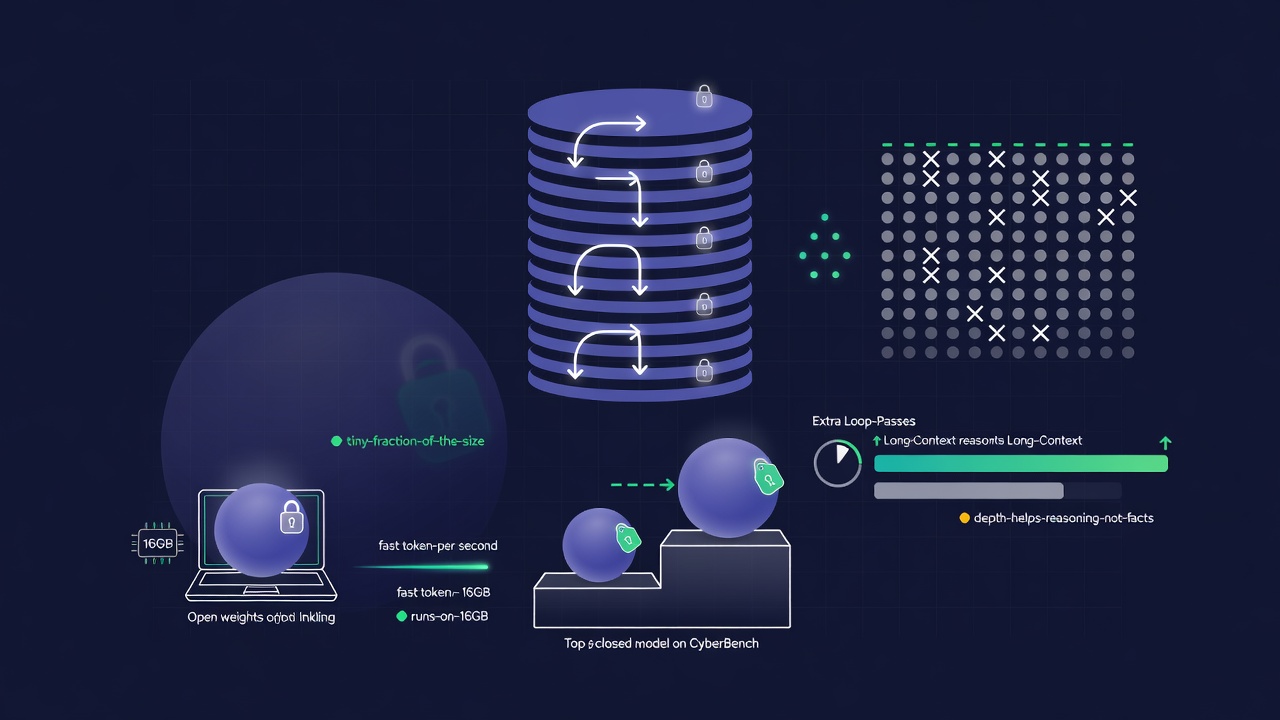
The architecture is the part worth slowing down on. Rather than a deep stack, there are 12 shared core layers that run for 3 passes, with gated messages carried between passes, a design the vLLM team detailed at launch. Thinking Machines trained it by pruning two-thirds of the experts during mid-training and then distilling logits from a larger Inkling. The lab also shipped a companion research model, TML-d24-varloop-research, that lets you vary the number of loops at inference. Long-context scores such as GraphWalks and MRCR v2 improve as you add passes, while knowledge benchmarks like SimpleQA do not, which is roughly what you would expect if the loops buy reasoning depth rather than new facts.
The numbers
For a model this size, the benchmark picture is hard to argue with. It leads open models under 100B on DeepSWE v1.1 and the Vals Index v2.2, and Artificial Analysis places it on the Pareto frontier for intelligence versus active parameters.
| Benchmark | Result | Note |
|---|---|---|
| DeepSWE v1.1 | 48.2% | leads open models under 100B |
| Vals Index v2.2 | 46.5% | leads open models under 100B |
| AA Index | 20.1 | on the intelligence-vs-active-params frontier |
| ARC-AGI-2 | 49.3% | $0.14 / task |
| CyberBench | ties Opus 5.5 | under a quarter of the cost |
Vals found it ties Claude Opus 5.5 on CyberBench while costing under a quarter as much, and it keeps 96 to 97% of the larger Inkling 2 Small's Vibe Code and SAGE scores. Ziqiao Ma's comparison is the one that lands hardest: it reportedly beats Inkling 1.0 at 2.7% of the size. The loop design is clearly doing work that raw parameter count used to.
Why it matters
The news here is not one more open model. It is that the open frontier keeps sliding down into hardware people already own. A 26.4B model that quantizes to 16GB of RAM means a genuinely useful local model on a mid-range laptop, with no endpoint to rent and no per-token meter running. We track where this trend sits in our rundown of the best open-source AI models in 2026, and Inkling 2 Mini is the clearest "runs on your machine" entry yet.
The looped architecture also changes the cost math. When a small model can be dialed to think harder at inference instead of being replaced by a bigger one, the cheapest capable option for a given request shifts around a lot. That is exactly the case for not standardizing on one model: send each request to whatever handles it well for the least money, which we lay out in routing requests across open models. Thinking Machines framed the open release around interpretability too, saying the point is to let researchers study how loops affect whether a model's chain of thought stays monitorable, with Goodfire and NDIF already publishing tooling to trace information flow across the passes.
Video: how looping makes a small model smarter
A walkthrough of the looped-transformer idea behind Inkling 2 Mini and what it means for running capable models locally.
FAQ
How is Inkling 2 Mini different from Inkling 2 Small?
Size and target. Inkling 2 Small is a 594B total, 17B active model built for hosted use. Inkling 2 Mini is a 26.4B looped model built to run locally, down to a 16GB laptop. We covered the bigger sibling in our writeup of Inkling 2 Small.
Can I actually run it on my own hardware?
Yes, which is the point. It had day-0 support in vLLM, Ollama, transformers, llama.cpp, and MLX, and Unsloth's GGUF quants target 16GB of RAM. A DGX Spark reportedly hit about 75 tokens per second.
What does "looped" mean here?
Instead of adding more layers, the model runs a shared 12-layer core three times and passes gated messages between passes. It gets reasoning depth closer to a larger model without the larger model's size, and a research variant lets you tune the number of passes per request.
Should I switch to it from a hosted frontier model?
For most people the better move is access to several models rather than committing to one. Tools that put multiple AI models behind one subscription let you reach for a local open model or a hosted frontier model depending on the task.
Sources
- @thinkymachines - Inkling 2 Mini launch
- @miramurati - small enough for a laptop
- @vllm_project - 12 core layers, 3 passes, gated messages
- @ArtificialAnlys - 3.4B active, 1M context, Pareto frontier, AA Index 20.1
- @eliebakouch - two-thirds of experts pruned, logit distillation
- @teortaxesTex - leads open models under 100B on DeepSWE v1.1 and Vals
- @ziqiao_ma - beats Inkling 1.0 at 2.7% of the size, varloop research model
- @ValsAI - ties Opus 5.5 on CyberBench at under a quarter of the cost
- @teortaxesTex - ARC-AGI-2 49.3% at $0.14/task
- @soumithchintala - ~75 tok/s on DGX Spark, roughly as good as Qwen 3.8 27B
- @UnslothAI - GGUF quants targeting 16GB RAM
- @AlexRobey23 - open release to study loops and monitorability
Further reading
Try all the models mentioned in this article
Admix gives you GPT-5, Claude, Gemini, and 300+ AI models in one app. Compare responses side by side. Try it for 7 days for $1.99.
Try Admix for $1.99