Kimi K3.1 Pro Lands Fourth on the Intelligence Index, and the Weights Drop November 4
Quick verdict
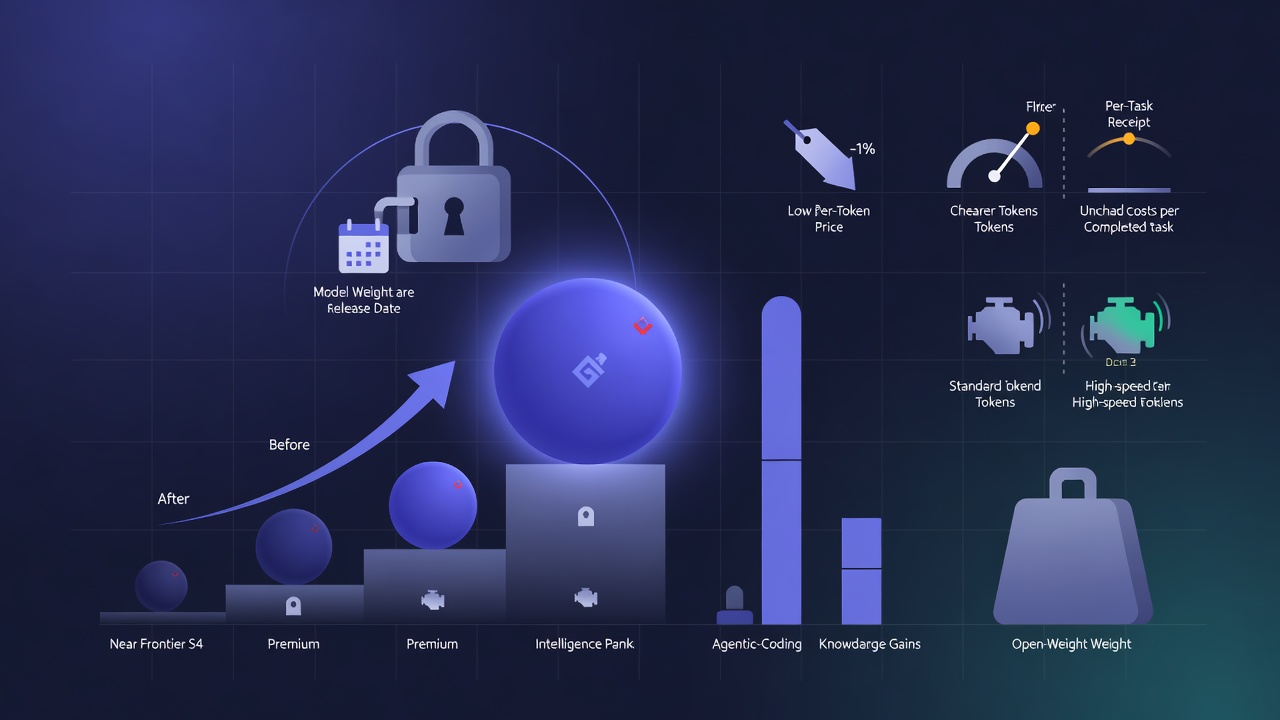
Moonshot launched Kimi K3.1 Pro and it is the closest an about-to-be-open model has come to the frontier. Artificial Analysis put it fourth on its Intelligence Index at 55, behind Claude Opus 5.5 at 58 and a tie between Sonnet 5.5 and Muse Wonder Full at 56. The API is live now; the weights are promised for November 4, with the license still unconfirmed. Token prices dropped a third versus K3, but the catch is the same one that followed every Kimi release this year: cheaper tokens do not mean cheaper finished work, because the model spends more of them to get there.
What actually shipped
K3.1 Pro is a multimodal mixture-of-experts model that Moonshot describes as 3T-class: 2.8 trillion total parameters, 104 billion active, and a 1-million-token context window. Its advertised strengths are full-project coding, Blender and CAD work, financial modeling, and long-running agents. It launched in two flavors across kimi.com, the Kimi apps, Kimi Work, Kimi Code, and the API. The Highspeed version generates output 2 to 3 times faster while preserving intelligence, and the official summary says it costs twice as much. Alongside the model, Moonshot shipped Kimi Hosted Agents, a managed harness with a 24/7 execution environment for long-running and multi-agent work.
At launch the API was available but the weights were not. Moonshot says they land by November 4, and Artificial Analysis recorded them as unpublished. That gap matters, because the tweets from launch day do not settle the eventual license, redistribution terms, or commercial-use restrictions. "Soon-to-be open-weight" is the honest description, not "open source," whatever the launch-day replies called it.
The benchmark jump is real, and uneven
The size of the improvement over K3 is what got people talking. Artificial Analysis ran both and the deltas are large where the model got agentic and smaller where it got smarter in the textbook sense.
| Evaluation | Kimi K3 | K3.1 Pro |
|---|---|---|
| Intelligence Index | 44 | 55 |
| Terminal-Bench 4.0 | 13% | 67% |
| AutomationBench-AA | 58% | 73% |
| Humanity's Last Exam | 47% | 52% |
| AA-Omniscience Index | 20 | 30 |
Terminal-Bench went from 13% to 67%, the highest in AA's run, and GDPval climbed 312 Elo to 1,846, third behind Opus 5.5 and Wonder Full. The knowledge gains were more modest: five points on Humanity's Last Exam, a couple on the science evals. Hallucination on AA-Omniscience fell from 53% to 44%, a genuine improvement but not the 65% finance-specific reduction Moonshot advertised, which is a different measurement on a workload nobody outside the company has verified. On Arena's Code Arena WebDev it took #8 at 1,692 points, up nine places over K3, roughly matching Opus 5 Max at these settings rather than the newer Opus 5.5.
Simon Willison called it the first prospective open-weight release to compete this credibly with the current frontier. Artificial Analysis made the same point in numbers: once the weights are out, it says the gap between the leading open and proprietary models on its Intelligence Index would narrow from 12 points to three. That is a statement about one index, not about every task, but it is the smallest that gap has been.
Cheaper tokens, same cost per task
Standard pricing is $2 per million input tokens, $10 output, and $0.20 cached input, down a third from K3's $3 / $15 / $0.30. On paper that undercuts Opus 5.5's quoted $4 / $20 by half and Astra's $10 / $50 by eighty percent. The problem is that list prices are not what you pay to finish a job.
| Workload | K3.1 Pro cost per task | Versus K3 |
|---|---|---|
| AA Intelligence Index | $1.98 | roughly unchanged |
| Arena Code Arena WebDev | $1.23 median | 29% lower |
| AA Cyber Index | $2.81 | 15% higher |
On the Intelligence Index the model generated 55,000 output tokens per task against K3's 48,000, about 14% more, which eats most of the price cut. On the cyber suite it burned roughly twice the input tokens, so the per-task cost rose even though the rate fell. Arena's WebDev number is the one that looks genuinely cheap: $1.23 median, 74% below Opus 5 Max and 24% below GPT-6 Sol Max with more preference points. So the cost story is workload-dependent, which is exactly why a single headline price tells you nothing useful.
Why this matters if you pay for AI
This is the pattern that keeps repeating. A capable near-open model shows up at a fraction of the closed-model sticker price, usage starts routing toward it for the work where it is good enough, and the premium tiers have to earn their cost on the tasks that actually need them. K3.1 Pro's twist is that the per-token discount and the per-task cost point in different directions, so the only honest way to decide is to measure your own workload rather than trust the launch slide.
If you are juggling several models and trying to keep the bill down, the move is the same as it has been all year: send the easy work to the cheap capable model, keep a frontier model for what genuinely needs it, and switch between them without paying for three separate subscriptions. That is the whole case for running your models through one aggregator instead of stacking monthly plans, and our writeups on routing requests to the cheapest capable model and the best open-source AI models in 2026 both go deeper on how to split the work.
Video: a first look at Kimi K3.1 Pro
Arena's walkthrough of what shipped, the benchmark claims, and whether Moonshot has actually closed the gap.
FAQ
Can I download the Kimi K3.1 Pro weights?
Not yet. Moonshot promises them by November 4, 2026, but at launch only the API was live, and the license terms are not confirmed. Even once the weights are out, this is a 2.8-trillion-parameter model, so it is a hosted-inference model for almost everyone rather than something you run at home.
Is K3.1 Pro actually cheaper than Claude Opus 5.5?
Per token, yes, by about half. Per finished task it depends on the job. On Artificial Analysis's Intelligence Index its cost barely moved from K3 because it generates more output tokens, while on Arena's WebDev tasks it came in 74% below Opus 5 Max. Measure your own workload before assuming the token discount carries through.
How good is it at coding?
Strong, and that is where most of the gain concentrated. Terminal-Bench 4.0 jumped from 13% to 67%, the top result in Artificial Analysis's run, and it reached #8 on Arena's Code Arena WebDev board. Knowledge and science evals improved far less, so the model is sharper as an agent than as an encyclopedia.
Sources
- @Kimi_Moonshot - K3.1 Pro architecture, rollout, and promised weight release
- Artificial Analysis - K3.1 Pro independent capability and pricing results
- Arena - K3.1 Pro at #8 on Code Arena WebDev
- Artificial Analysis - K3.1 Pro cyber evaluation
- @simonw - first prospective open-weight release to compete this credibly
- @ZhihuFrontier - standard and Highspeed pricing summary
Further reading
Try all the models mentioned in this article
Admix gives you GPT-5, Claude, Gemini, and 350+ AI models in one app. Compare responses side by side. Try it for 7 days for $1.99.
Try Admix for $1.99