OpenAI Says It Proved a Millennium Problem With 10,000 Agents. The Bigger Story Is the Compute Bill.
Quick verdict
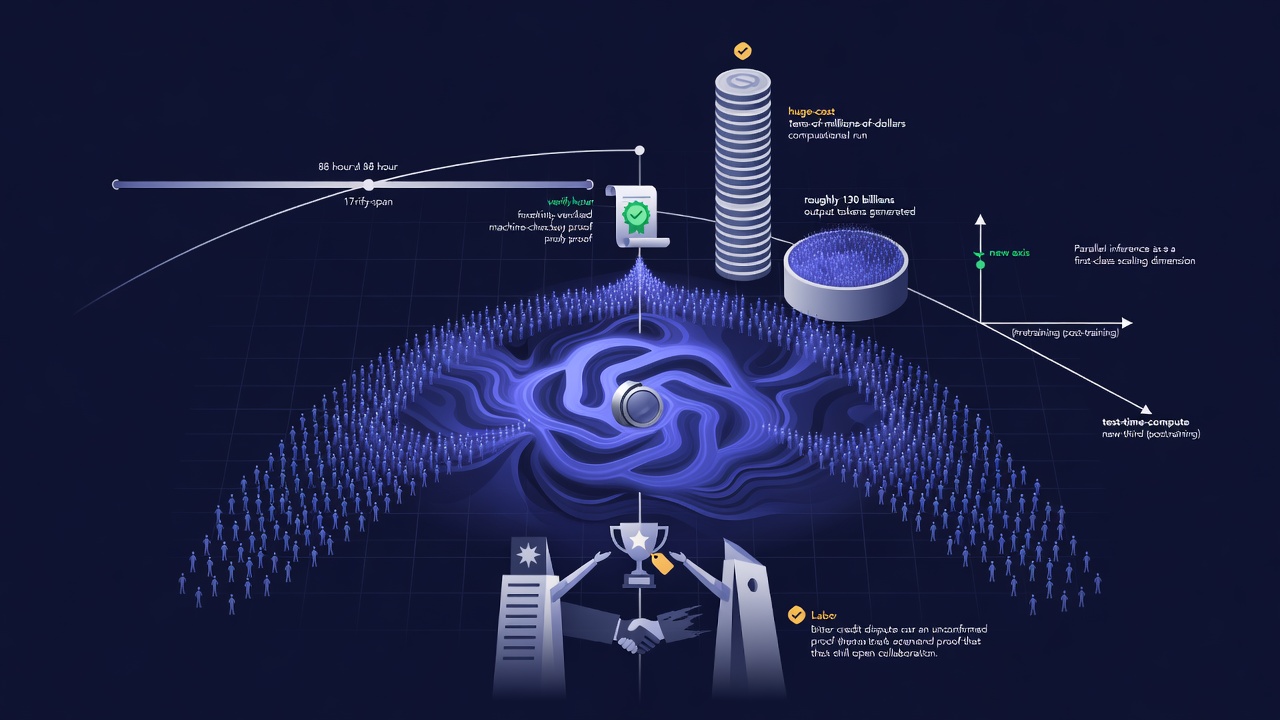
OpenAI said an internal model, one it describes as significantly more capable than GPT-6 Astra, produced a proposed proof of the Navier-Stokes existence and smoothness problem, one of the Clay Millennium problems. The run used roughly 10,000 agents working in parallel for 88 hours, followed by another 17 hours of Lean formalization and verification with Astra. Mathematicians have not confirmed the proof, and the priority fight around it got personal fast. Strip out the drama and the durable takeaway is about economics: this is the clearest sign yet that unstructured parallel test-time compute is now a real scaling axis, separate from pretraining, and that the price of a single hard result can run into the tens of millions of dollars before it collapses toward consumer prices.
What OpenAI actually claimed
OpenAI posted that its internal system produced a proposed Navier-Stokes proof over 88 hours using about 10,000 agents, then spent another 17 hours turning it into a machine-checked Lean proof with Astra. The company was careful to say its result differs from work by independent researchers and addresses a different Euler setting. It also said no specific user data was accessed for the effort, while conceding it cannot rule out that de-identified derivative data from past product usage helped improve the model in general.
The result has not been verified by the mathematics community, and that caveat matters. A proposed proof of a Millennium problem is a claim, not a settled fact, until people who do this for a living have gone through it line by line. What is not in dispute is the shape of the compute run, because OpenAI described it and outside observers did the arithmetic.
The number to sit with is the compute
Several people tried to price the run. The estimate that stuck put it at around 130 billion output tokens and somewhere between $10 million and $40 million in API-equivalent cost, depending on how much input token volume you assume. That is one math problem. The technical meta-point, which several researchers made at once, is that this is a new axis. Pretraining scale and post-training were the two knobs everyone talked about. Now there is a third: throw thousands of agents at a problem at inference time, orchestrate them, and let raw test-time compute do the work.
The optimistic framing came from Noam Brown, who pointed out that ARC-AGI costs fell from hundreds of thousands of dollars per task to tens of dollars in a short window, and argued the same collapse will happen here. What costs $10 million to $40 million today could be a consumer-accessible query before long. The pessimistic reading is simpler: for now, the frontier of what AI can do on the hardest problems is gated by a budget most labs cannot spend, which concentrates that capability in a handful of companies.
| What OpenAI reported | Figure |
|---|---|
| Agents run in parallel | ~10,000 |
| Proof search time | 88 hours |
| Lean formalization and verification | 17 hours (with Astra) |
| Estimated output tokens | ~130 billion |
| Estimated API-equivalent cost | $10M to $40M |
Then the credit fight started
This is where the story stopped being about math. Sam Altman and Sebastien Bubeck told a version where OpenAI heard rumors that Anthropic-associated researchers had solved a Millennium problem, and then tested whether OpenAI's own models could do the same. When OpenAI learned the other team had Euler but not Navier-Stokes, it says it offered coordination, priority on Euler, and possible lead authorship for mathematician Tristan Buckmaster on a rewrite of OpenAI's proof.
Critics were less worried about literal spying, which most of them thought unlikely, and more worried about two things. First, whether derived user data or public rumors should have triggered stricter internal checks before OpenAI raced to match a competitor's private result. Aidan Gomez, John Schulman, and Simon Willison all pushed on the norms question rather than the espionage question. Second, and this is the part mathematicians care about, whether this behavior chills open scientific exchange. If word that a lab is close to a breakthrough is enough to trigger an industrial-scale effort to beat them to it, researchers learn to stop talking.
Terence Tao's cautionary comments, amplified by Francois Chollet and Gary Marcus, framed the real risk: if even a rumor of progress can set off a compute effort that flattens a whole research direction overnight, fields drift toward secrecy and away from the open-science norms that made them productive. Steven Strogatz added the credit reminder that gets lost in launch threads, noting that earlier public work by Cordoba and Martinez-Zoroa supplied a key strategy others built on. Nobody solves these things from a blank page.
Why it matters for everyone else
Most readers are not going to spend $40 million on a math proof. The reason this matters anyway is what it signals about where AI cost and capability are heading. The lesson labs are drawing is that you can buy your way to harder results with parallel inference, which means the compute bill for the very top end is about to get much larger before efficiency drags it back down. That is the same dynamic, at an extreme, that already makes routing between models by cost the sane way to run a real workload. We walked through that logic in the 2026 coding model roundup, where the frontier model is rarely the right default for high-volume work.
It also lands in a week where the same trick, AI plus formal verification on famous open problems, keeps recurring across labs. Anthropic's own math results, including the Claude Riemann hypothesis lower-bound work, are part of the same competitive race that produced this credit fight. When the labs are racing on prestige math and briefing reporters about who solved what first, the honest move for a paying user is to ignore the leaderboard theater and pick per job. Running several models through one interface, so you can send each request to whatever wins on quality per dollar that week, is the practical version of that. We break that approach down in the multi-model app guide.
Video: the Navier-Stokes claim explained
A walkthrough of what the Millennium problem is and what a proposed AI proof does and does not mean.
FAQ
Did OpenAI actually solve Navier-Stokes?
It claimed a proposed proof, not a confirmed one. A Millennium problem is only considered solved after the mathematics community verifies the argument, which had not happened at the time of writing. OpenAI also said its proof addresses a different Euler setting than the independent researchers' work it was compared against.
What is test-time compute and why does this run matter?
Test-time compute is the work a model does at inference, when it answers, rather than during training. Running roughly 10,000 agents in parallel for 88 hours is a large bet that throwing more inference at a hard problem produces better results. This run is being cited as evidence that parallel test-time compute is now a first-class scaling axis alongside pretraining and post-training.
How much did it cost?
OpenAI did not publish a dollar figure. Outside estimates put the run at roughly 130 billion output tokens and somewhere between $10 million and $40 million in API-equivalent cost, depending on assumptions about input volume.
What was the fight with Anthropic about?
It was a priority and norms dispute. OpenAI said it acted after hearing rumors that Anthropic-associated researchers were close to a Millennium result, and offered to share credit. Critics, including several mathematicians, worried less about spying and more about whether racing to match a rumored competitor result will push researchers toward secrecy.
Sources
- @OpenAI - proposed Navier-Stokes proof and data claims
- @sama - the 88-hour, 10,000-agent run
- @sama - priority, coordination, and authorship offer
- @SebastienBubeck - OpenAI's account of the sequence of events
- @polynoamial - test-time compute economics and the ARC-AGI cost analogy
- @scaling01 - 130B token and $10M to $40M cost estimate
- @aidangomez - the derived-data and norms critique
- @johnschulman2 - on scientific norms and stricter checks
- @simonw - skepticism on spying, focus on process
- @fchollet - amplifying Terence Tao's caution on open science
- @stevenstrogatz - prior work by Cordoba and Martinez-Zoroa
- r/OpenAI - Millennium prize solution discussion
- r/OpenAI - the credit-dispute thread
Further reading
Try all the models mentioned in this article
Admix gives you GPT-5, Claude, Gemini, and 350+ AI models in one app. Compare responses side by side. Try it for 7 days for $1.99.
Try Admix for $1.99