Claude Pushed a 90-Year-Old Math Bound From 41.6% to 67.2%
Quick verdict
Anthropic reported that an unreleased research version of Claude improved a longstanding lower bound connected to the Riemann Hypothesis, raising the proven fraction of the zeta function's zeros on the critical line from 41.6% to 67.2%. To be clear, it did not prove the Riemann Hypothesis. What it did is a real, checked improvement to a hard problem in analytic number theory, produced by a swarm of agents grinding for a day and a half. That process is the story.
What actually shipped
Anthropic published the result along with a workflow description that reads more like a research lab than a chatbot session:
- The bound moved from 41.6% to 67.2%, a jump of 25.6 percentage points on the fraction of nontrivial zeros known to lie on the critical line. It builds on prior machinery from Baluyot, Goldston, and others, combined with a Weil-induced quadratic-form framework.
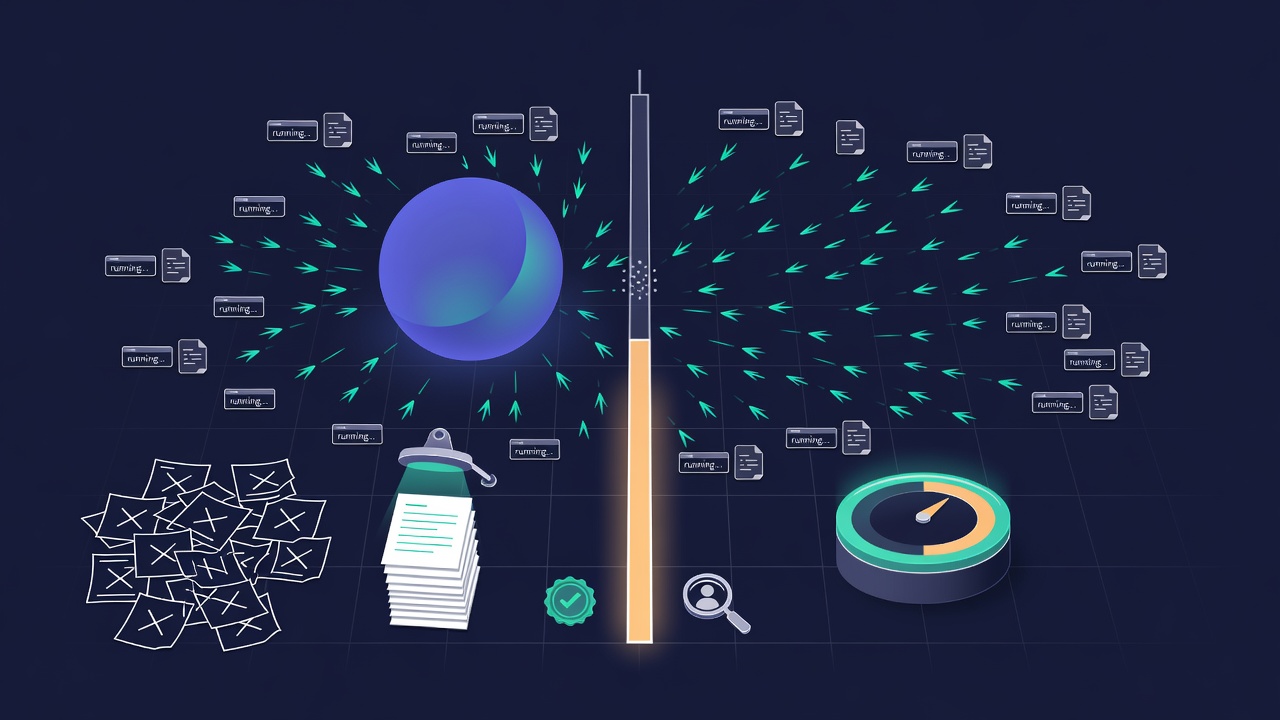
- Claude first generated roughly 650 failed ideas before finding a path that held up.
- The winning run used around 60 Claude subagents over about 1.5 days, executing 2,400 shell commands and writing hundreds of Python scripts.
- Those subagents ran thousands of numerical checks against known zeta zeros, downloaded 54 arXiv papers to check for novelty, re-proved the result independently, drafted a paper, and produced a Lean formalization. Internal and external mathematicians reviewed it.
- It burned over 31M output tokens getting there.
One detail that stuck with engineers watching: a lot of what kept Claude going through the failures was plain motivational prompting. Telling the model to keep going, retry, and explore more helped it persist past dead ends. That is a strange thing to write about a proof search, and it is exactly why the result drew attention.
Why it matters
The temptation is to read this as "AI is about to solve the Riemann Hypothesis." It is not. A better lower bound is progress, not a proof, and there is no guarantee the same method extends toward 100%. Mathematicians in the reactions were careful about that.
The useful signal is about the shape of the work. This was not one clever prompt. It was orchestration: many agents, thousands of tool calls, numerical verification, literature review for novelty, independent re-proof, and formalization in Lean so the result could be machine-checked. That is a template for using models on genuinely open problems, where the value comes from tireless search and verification rather than a single flash of insight. For anyone building agent systems, the takeaway is that persistence, tool use, and checking are doing the heavy lifting, not raw model IQ alone.
Anthropic paired the research news with a pricing move the same week, making Claude Sonnet 5's introductory rate permanent at $2 per million input tokens and $10 per million output. The two are unrelated on the surface, but together they read as a company pushing on both capability and cost while the open-weight field closes in.
What it did and did not do
| Claim | Reality |
|---|---|
| Solved the Riemann Hypothesis | No. It improved a related lower bound. |
| Improved the critical-line bound | Yes, from 41.6% to 67.2%. |
| Worked alone in one prompt | No. ~60 subagents, 2,400 shell commands, 1.5 days. |
| Verified the result | Independent re-proof plus a Lean formalization, reviewed by mathematicians. |
| Output cost | Over 31M output tokens. |
Video: Claude and the Riemann Hypothesis
For context on what this result means and where it fits, watch this.
FAQ
Did Claude prove the Riemann Hypothesis?
No. It improved a lower bound on the fraction of the zeta function's nontrivial zeros known to lie on the critical line, from 41.6% to 67.2%. The conjecture itself remains open.
How did it get there?
Anthropic used about 60 Claude subagents over roughly 1.5 days, running 2,400 shell commands, hundreds of Python scripts, and thousands of numerical checks. It also re-proved the result independently and formalized it in Lean, then had human mathematicians review it.
Is this a normal thing to run with Claude?
Not exactly. This used an unreleased research variant and a heavy multi-agent setup that burned over 31M output tokens. It is a demonstration of orchestrated agent search on a hard problem, not a feature you flip on.
Sources
- @AnthropicAI - Claude improves the RH-related lower bound
- Anthropic - the research writeup on the zeta result
- @jarredsumner - on the retries and 31M output tokens
- @claudeai - Claude Sonnet 5 pricing made permanent
- r/singularity - discussion of the bound and the workflow
Further reading
Try all the models mentioned in this article
Admix gives you GPT-5, Claude, Gemini, and 350+ AI models in one app. Compare responses side by side. Free to start.
Start free on Admix