An Anthropic Mathematician Says He Proved the Riemann Hypothesis With Claude. The Lean Code Is Still Compiling.
Quick verdict
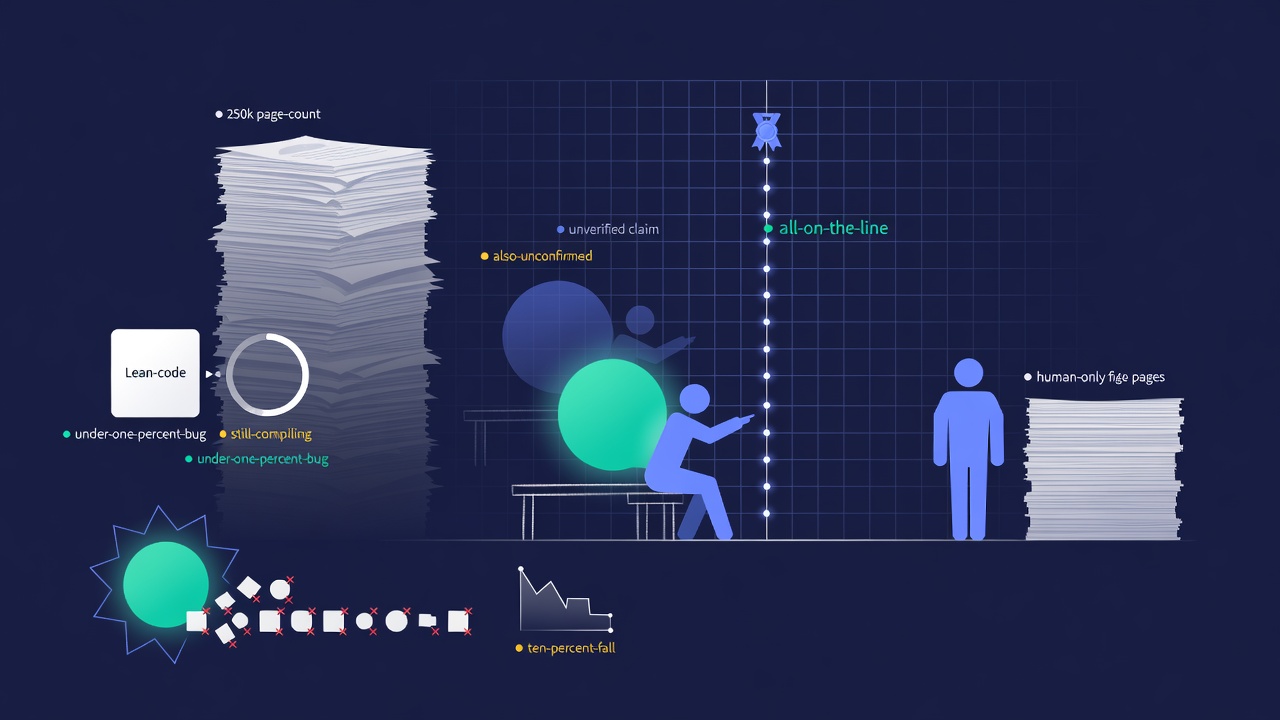
On November 20, Levent Alpöge, a mathematician at Anthropic, said that working with Claude he had found a proof of the Riemann Hypothesis, and that the same method also settles the Generalized Riemann Hypothesis. If it holds up, it is one of the biggest results in modern mathematics. The catch sits in that "if." When the claim went public, the Lean formalization was still compiling, no prose proof had been released, and a separate human mathematician had announced his own proof of the same conjecture days earlier. Treat this as an unverified claim with unusually good odds, not a settled fact.
What was actually claimed
The Riemann Hypothesis is one of the seven Millennium Prize Problems. It says every non-trivial zero of the Riemann zeta function sits on a single vertical line in the complex plane, the critical line. That one statement controls how evenly the prime numbers are distributed, which is why it has resisted every attack since 1859. The Generalized Riemann Hypothesis extends the same claim to a much wider family of L-functions, so proving GRH is strictly harder than proving RH alone.
Alpöge says he has both. A few details from the announcement are worth pinning down:
- What was released is a formal proof written in Lean, the proof-checking language. The prose version reportedly ran past 250,000 pages, which is not a document any human reads end to end.
- The timeline is tight. Work began on October 6. Eight of the 20 proof steps landed on November 15, and the final entry, dated November 16, simply reads "GRH."
- Alpöge credits Claude for the sections involving automorphic forms on higher-rank groups, an area he says he has little mastery of himself.
- Nobody has said which Claude model was used, or how much of the work came from human steering versus the model.
What is confirmed and what isn't
This is the part that matters, and it is easy to skip past in the excitement.
Elliot Glazer checked the formalized statement and confirmed it really is GRH, not a weaker lookalike that happens to share the name. That rules out the most common way these announcements fall apart, where the thing that got proved turns out not to be the famous conjecture. Glazer also said the Lean code was "still compiling, will take a few hours," and put the chance of a bug in the formalization at well under 1 percent.
So the honest status at publication: the statement is the right one, the proof is written in a language a machine can check, and the check had not finished. A Lean proof that compiles clean is about as close to certainty as mathematics offers. One that is still running is a promise.
Artificial Analysis added the useful context: this is now the second AI-claimed Millennium result sitting in the unverified column. The first was OpenAI's September Navier-Stokes claim, which leaned on an unreleased model and never produced an artifact anyone outside the lab could check. Two claimed Millennium proofs in three months, neither fully confirmed, is a pattern worth watching rather than a scoreboard.
The human proof nobody is talking about
Days before the Anthropic news, Alessandro Masullo announced a separate proof of the Riemann Hypothesis done entirely by hand, reported as a roughly 940-page draft covering GRH. Two independent proofs of a 166-year-old problem landing in the same week is either a remarkable coincidence or a sign that something in the surrounding toolkit finally matured. Either way, the human draft is a useful control: if both hold, the AI version isn't doing something no human could reach, it is doing it faster and at a scale a person wouldn't attempt.
Why it matters for everyone else
You are not going to use a GRH proof. The reason this is worth your attention is what it says about where frontier models are, and where they very much aren't.
The optimistic read, from people like Theo Jaffee and Ege Erdil, is that we have never actually known how objectively hard these problems are. Maybe the Riemann Hypothesis was always a brute-force search that no human had the patience to run, and the model just had the patience. Others framed it as olympiad-style "bashing," grinding through mechanical casework at a scale humans give up on. That is a real capability, and it is not the same thing as insight.
Then there is the jaggedness. Omar Khattab pointed out the obvious tension: the same model that may have settled a Millennium problem is "this dumb on 1000 other things." That gap is the whole story of using these tools in 2026. A model can be superhuman on a narrow, verifiable task and still trip over something a careful intern would catch. It makes the case for not betting your work on a single model's output, which is the argument for keeping several models within reach rather than marrying one.
The market noticed the uncertainty too. Anthropic's stock fell about 10 percent on the day, which tells you investors read the headline as a question, not an answer.
Video: Claude and the Riemann Hypothesis
A walkthrough of the claim, what Lean verification actually proves, and why the math community is holding its applause.
FAQ
Did Claude prove the Riemann Hypothesis?
Not confirmed. A mathematician at Anthropic claims a Claude-assisted proof of RH and GRH, but the Lean formalization was still compiling when the claim went public and no reviewed prose proof has been released. The formal statement has been checked to be the real conjecture, which is a meaningful step, but "the proof compiles" is not the same as "the proof is public and verified."
How is this different from the earlier Claude Riemann result?
Very different. Back in August, Anthropic reported that a research Claude improved a known lower bound tied to the hypothesis, pushing the proven fraction of zeta zeros on the critical line from 41.6 percent to 67.2 percent. That was a real, checked partial result, not a solution. This new claim is for the full conjecture, which is a categorically larger statement.
What does the 250,000-page figure mean?
That is the reported length of the prose write-up, the human-readable version of the argument. Nobody reviews a document that size by reading it. The actual verification path is the Lean code, where a machine checks every logical step, which is why the compile result matters more than the page count.
Can AI really do frontier mathematics now?
On narrow, formally verifiable problems, the evidence is mounting that it can contribute real results. See the broader pattern in AI-assisted proofs across number theory and physics. The honest caveat is that these wins are jagged: strong where the answer can be checked by a machine, unreliable almost everywhere else.
Sources
- Scientific American - Anthropic mathematician claims a Riemann Hypothesis proof
- @kimmonismus - summary of the Alpöge statement and method
- @eliebakouch - timeline breakdown and Claude's role in the automorphic-forms steps
- @ElliotGlazer - the formalized statement is GRH, Lean still compiling, bug odds under 1%
- Artificial Analysis - both AI-claimed Millennium results remain unverified
- @KSHartnett - separate, fully human proof of RH announced by Alessandro Masullo
- @lateinteraction (Omar Khattab) - on model jaggedness
- @scaling01 - Anthropic stock fell about 10% on the day
Further reading
Try all the models mentioned in this article
Admix gives you GPT-5, Claude, Gemini, and 300+ AI models in one app. Compare responses side by side. Try it for 7 days for $1.99.
Try Admix for $1.99