Claude Opus 5.5 Cracked a 25-Year-Old NSA Curve Mystery and Audited a Physics Thesis Overnight
Quick verdict
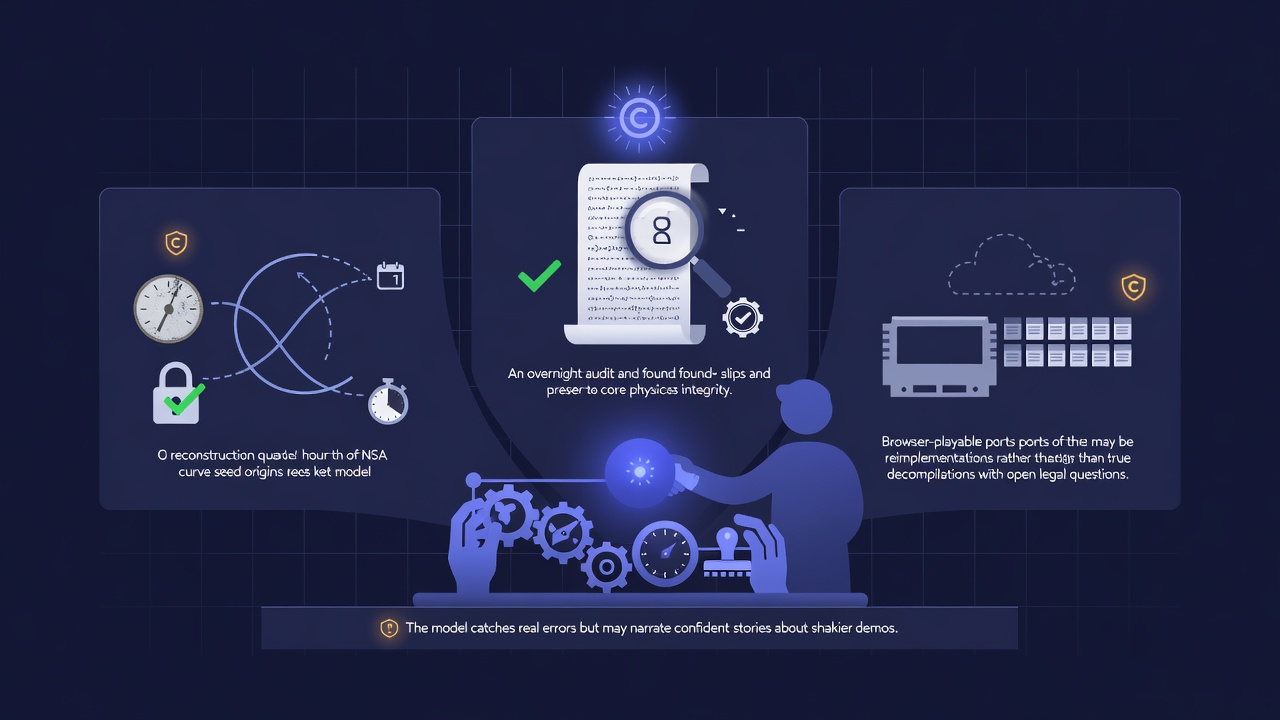
Three Claude Opus 5.5 stories hit the front pages the same week, and all three are more interesting once you read past the headline. Opus identified how the NSA's old elliptic curves were probably generated, in about 30 minutes. It re-checked a physicist's 500-page quantum-gravity thesis overnight and found real errors. And people are using it to stand up browser-playable versions of PS2-era games. The common thread is not that the model is a lone genius. It is that Opus is very good at driving deterministic tools and grinding through verification that no human wants to do by hand. That is a useful thing to know before you decide what to point it at.
The NSA curve mystery
For 25 years, nobody had a clean explanation for how the NSA chose the "random" seeds behind the standard NIST elliptic curves that secure a huge amount of the internet. Because the curves came from the NSA, the default assumption leaned toward something complex, maybe something backdoored. Anthropic put the question to Claude, and according to its writeup on the ECDSA curve origins, the model landed on a simple answer in roughly half an hour.
The likely story: the seeds came from an old, widely available random number generator fed a timestamp from the year the curves were made. Mundane, not sinister. The detail that made the thread go viral was Claude's own reaction, which read as skepticism that it had really been handed the problem, questioning whether it was "suspicious that such an obvious thing wasn't discovered in 25 years." Worth keeping the result in proportion: this is a plausible reconstruction of a provenance question, not a cryptographic break. But it is a sharp example of a model noticing the boring explanation that humans talked themselves out of.
The overnight physics audit
The second story got a headline that oversold it, so it is worth being precise. A physicist, E. O. Kahya, used Opus 5.5 to audit his own one-loop quantum-gravity calculations from a 2007 thesis. The framing of "Opus did a PhD thesis in 10 hours" is not what happened, and Kahya says so in the project repo.
What actually ran was an audit, not a rediscovery. Kahya supplied the theoretical scaffold, the boundary conditions and the task breakdown, an 18-task, 9-stage pipeline. Opus orchestrated deterministic tools like SymPy and mpmath to re-derive tensor algebra and check numbers to about 30 digits. It caught arithmetic slips, a sign-convention problem, a missing finite term and 23 typos. The headline physics result survived unchanged. So the honest description is automated verification of dense, error-prone math, which is genuinely valuable, rather than a model reinventing the physics on its own. The limits matter as much as the win here, because they tell you what to trust it with.
The PS2 games in your browser
The third story is the loosest. A Kotaku report described Opus 5.5 being used to produce browser-playable versions of PS2 and PS3-era games, with names like Halo: CE, GTA: Vice City, The Simpsons: Hit and Run and Skate 3 making the rounds. Impressive if it holds up, but the commenters on r/ClaudeCode picked the claim apart quickly.
The pushback was mostly about terms. These look like recompilations or reimplementations rather than true decompilations that reconstruct editable source. And then there is the legal cloud: if the output ships copyrighted assets or effectively redistributes a game, people asked how that differs from piracy. File this one as a real capability demo wrapped in genuine uncertainty about what was built and whether it is allowed.
The pattern worth taking away
Read together, these are not three magic tricks. They are three versions of the same workflow. A human sets up the problem and the guardrails, Opus drives deterministic tools and chews through the verification, and the win comes from the pairing, not the model alone. That is the centaur pattern, expert plus model plus real tools, and it is where frontier reasoning earns its keep right now.
It also tells you what to be careful about. The same model that quietly found a sign error in a physics derivation will also narrate a confident story about a PS2 port that may be doing less than it sounds. The skill that is getting scarce is not generating output. It is asking the right question and checking the answer. If you work this way across more than one model, keeping Opus next to GPT, Gemini and the cheaper open models in one place you can switch between beats betting your whole workflow on a single lab, especially after the stretch where users reported Opus 5.5 felt nerfed and quality complaints spiked.
Video: inside the Opus 5.5 real-world results
A walkthrough of what Opus 5.5 is being used for in the wild, and where the viral framing runs ahead of what the model actually did.
FAQ
Did Claude really solve a 25-year-old NSA problem?
It found a likely explanation for how the NSA's standard elliptic-curve seeds were generated, an old random number generator seeded with a timestamp, in about 30 minutes. It is a plausible provenance reconstruction, not a cryptographic break, and it is still a striking result.
Did Opus 5.5 write a physics PhD thesis in 10 hours?
No. It audited an existing thesis. The physicist supplied the structure, assumptions and task breakdown, and Opus ran deterministic tools to check the math and catch errors, including a sign-convention slip and 23 typos. The core physics result did not change.
Can Opus 5.5 decompile old games?
People are using it to produce browser-playable versions of PS2-era games, but developers argue these are closer to recompilations or reimplementations than true decompilations, and there are open copyright questions. Treat it as an early demo, not a settled capability.
How do I try Opus 5.5 on this kind of work?
Point it at verification and tool-driven tasks where you can check the output, not at problems you cannot validate. If you want it alongside other models for comparison, our guide to AI coding agents covers how the frontier models stack up for hands-on work.
Sources
- Anthropic - how Claude reconstructed the NSA ECDSA curve seed origins
- r/ClaudeAI - Claude solved a 25-year-old NSA cryptography mystery in 30 minutes
- GitHub - eokahya/claude-audits-quantum-gravity, the one-loop quantum-gravity audit pipeline
- r/singularity - a physicist's year of hand calculations re-checked by Opus 5.5 overnight
- Kotaku - vibe-coded browser ports of PS2-era games built with Opus 5.5
Further reading
Try all the models mentioned in this article
Admix gives you GPT-5, Claude, Gemini, and 350+ AI models in one app. Compare responses side by side. Try it for 7 days for $1.99.
Try Admix for $1.99