A Week After Launch, Paying Users Say Opus 5.5 Got Worse. Here's How to Prove It.
Quick verdict
About a week after Opus 5.5 shipped, two of the busiest Claude threads of the month are saying the same thing: the model that felt sharp on launch day now feels worse for the same work. The complaints are specific and they come from heavy users, not drive-by posters. But there is still no controlled benchmark showing a backend change, and a public sentiment tracker only tells us how people feel, not what Anthropic did. So treat this as a credible pattern worth watching, not a proven nerf, and if it matters to your workflow, start saving evidence today instead of arguing about vibes next week.
What people are actually reporting
The loudest thread, titled "Opus 5.5 nerfing: how to measure, how to spot, how to sue," came from a developer running complex C++, 3D, physics, and Blender MCP work. They say the model held up for five or six days, then started producing lower-quality code and oddly phrased output, and they want users to preserve launch-day prompts and outputs plus latency numbers so a drop can be detected rather than felt.
A second thread from a Claude Code enterprise pay-as-you-go user described a sharper version of the same thing. By their account Opus 5.5 Medium went from architecture-first, token-efficient implementation to verbose preambles, duplicated code, and the kind of token burn they associate with the older Opus 5. They claim usage climbed from roughly 70% to 90% of their limit in about an hour of normal work, with no change in what they were asking it to do.
Those are two posts, so the obvious question is whether this is a handful of people blaming the tool for a hard week. The reason it got traction is that the numbers point the same direction as the anecdotes.
What the numbers show, and what they don't
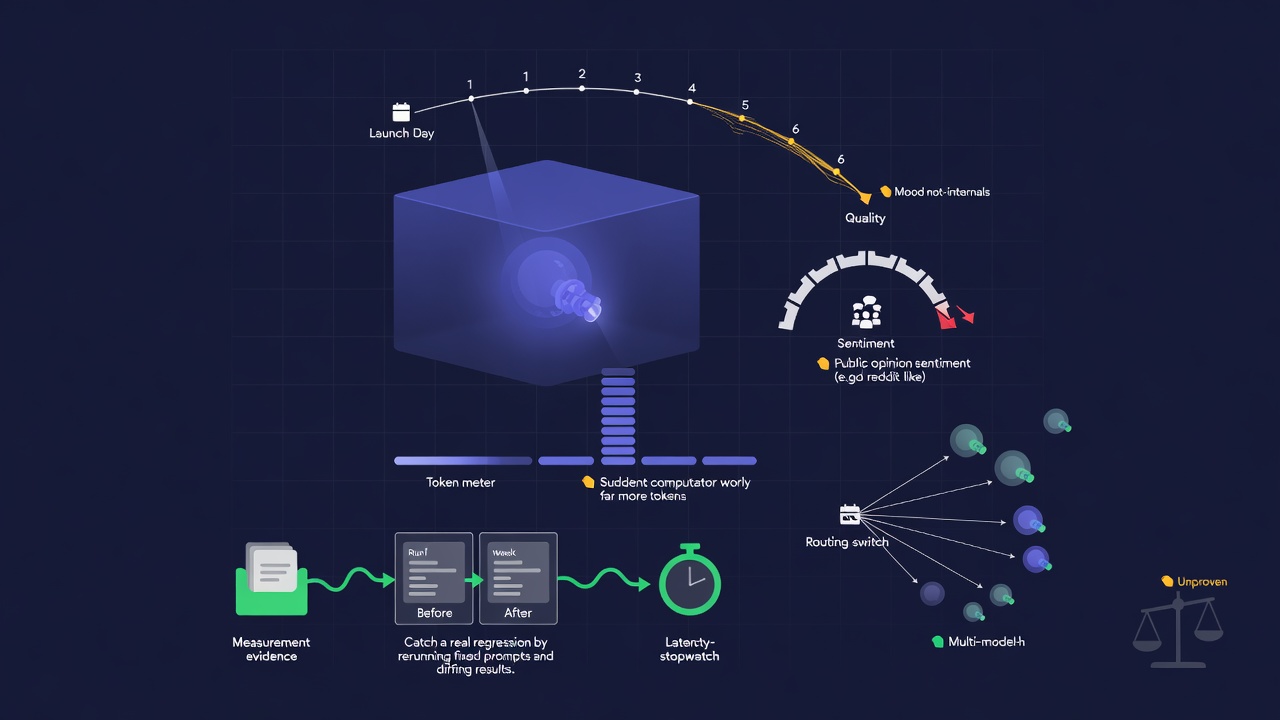
A commenter pointed to modelsentiment.com's Opus 5.5 page, which tracks Reddit sentiment. It sat around 71 to 73 out of 100 from September 25 through 28, then fell to 58 and then 55 over the following two days. That is a real slide, and it lines up in time with the complaints.
It is also exactly the kind of signal that is easy to over-read. Sentiment scores measure what people are saying, so once a "did Opus get nerfed" thread goes big, every follow-up post drags the number down regardless of whether the weights changed. The tracker catches mood, not model internals. It is suggestive, not proof.
| Signal | What it suggests | What it can't tell you |
|---|---|---|
| Reddit sentiment 71 to 55 in two days | A lot of users feel a drop at the same time | Whether weights, routing, or quantization changed |
| Token usage jumping 70% to 90% in an hour | Output got longer or less efficient for one user | Whether it generalizes beyond that account |
| "Mentions 3 things, acknowledges 2" reports | Possible instruction-following slip | Reproducibility without fixed prompts |
Why this is so hard to settle
With a hosted model you can see the output but not the machine. Weights, routing, serving configuration, and quantization all sit behind the API, and any of them can change without a version number moving. A provider under heavy load has real incentives to route some traffic to cheaper or faster serving paths, and users have no window into when that happens. That opacity is the whole problem. You cannot diff a model you cannot inspect.
This is not the first time the pattern has shown up either. Earlier this year an AMD AI director filed a GitHub issue with logs from thousands of Claude Code sessions arguing that thinking depth had dropped sharply after an update, which we covered in the thinking-depth story. The lesson from that episode holds here: feelings move fast, but only logs settle the argument.
One more wrinkle from this week's reports: Design Arena read 324 of Opus 5.5's thinking summaries and found it commits to an answer early in roughly four of five cases, while GPT-6 Astra hedges about twenty times as often. A model that commits early can read as confident on a good day and as careless on a bad one, which is part of why the same model can feel very different week to week even if nothing changed.
Video: testing whether Opus 5.5 quietly gets worse
This walkthrough runs the same tasks against Opus 5.5 over several days and shows the kind of before-and-after setup that turns a complaint into evidence.
How to actually catch a nerf
If model stability matters to your work, the fix is boring and it works: build your own baseline before you need it. The developers in these threads landed on the same handful of steps.
- Keep a fixed set of five to ten prompts you can rerun exactly, covering the work you care about.
- Save the launch-week outputs and the token counts alongside them, so you have a real before.
- Rerun the same prompts weekly and compare output quality, length, and tokens spent, not just how it felt.
- Log latency too. A sudden speedup paired with worse answers is the classic fingerprint of a cheaper serving path.
- Sample more than once per prompt. These models are random, so a single bad run proves nothing.
What you are doing is replacing "it feels off" with "here are two identical runs a week apart." That is the only thing that holds up in an argument, and it is also the only thing Anthropic can act on if there really is a regression.
The practical takeaway for people paying by the month
Changed or not, you are renting a model you cannot audit, on a plan whose value the vendor can quietly adjust. Loyalty to one lab does not protect you from that. Being able to move does. If your work can run on more than one model, a bad week on Opus is an annoyance instead of a crisis, because you route the task to whatever is sharp today. That is the case for keeping more than one model within reach rather than committing a whole workflow to a single flat subscription whose fine print keeps moving, a pattern we broke down in our look at AI subscription billing traps.
FAQ
Did Anthropic nerf Opus 5.5?
There is no proof. Heavy users report a quality drop about a week after launch and a public sentiment tracker slid from the low 70s to the mid 50s over two days, but no one has published a controlled benchmark showing a backend change. It is a credible pattern, not a confirmed one.
Can you sue over a model getting worse?
One thread raised the EU's Digital Content Directive 2019/770, which sets conformity and notice-of-modification rules for digital services, as a possible angle. It is an interesting argument, but you would still need to prove the service changed, which loops right back to the measurement problem.
Is this the same thing that happened with Claude Code earlier this year?
It rhymes. The earlier case had hard logs behind it from thousands of sessions, which is what made it stick. This round is mostly anecdotes plus a sentiment chart so far. See our write-up of the thinking-depth drop for how that one played out.
What is the fastest way to protect myself?
Keep a small fixed prompt set, save launch-week outputs and token counts, and rerun weekly. And keep a second model you can fall back to, so one bad week does not stall your work. Our cross-model comparison is a decent starting point for picking a backup.
Sources
- r/ClaudeAI - "Opus 5.5 nerfing: how to measure, how to spot, how to sue"
- r/ClaudeCode - "I didn't believe others at first, but something is suddenly off with Opus 5.5"
- modelsentiment.com - Claude Opus 5.5 sentiment tracker
- @DesignArena - reading 324 Opus 5.5 thinking summaries on hedging vs committing
- EUR-Lex - Digital Content Directive 2019/770
Further reading
Try all the models mentioned in this article
Admix gives you GPT-5, Claude, Gemini, and 350+ AI models in one app. Compare responses side by side. Free to start.
Start free on Admix