Claude Opus 5.5 Lands With a 20% Price Cut, and OpenAI Answered Within the Hour
Quick verdict
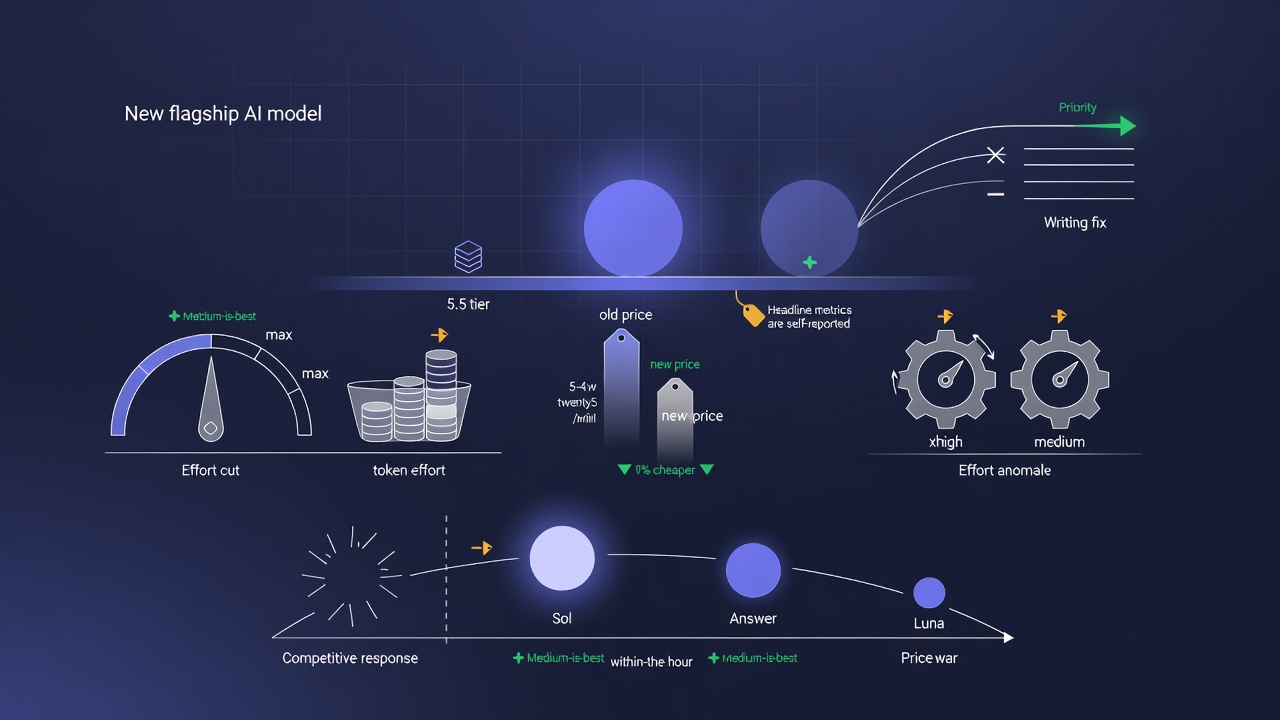
Anthropic shipped Claude Opus 5.5, the first model in a new 5.5 family, and the pitch is Fable 5.1-level quality at a lower price. The list rate fell 20% to $4 per million input tokens and $20 per million output, and Anthropic says the model runs about 40% cheaper and 30% faster than Opus 5 at default settings. OpenAI released GPT-6 Sol and Luna roughly an hour later at even lower prices. If you pay for AI by the task, the read is that both labs made speed and cost the headline this round, and the cheaper-token story comes with fine print worth reading before you switch.
What actually shipped
Opus 5.5 is now the default in Claude Code and the Claude app, including Cowork, and it is live in the Claude Platform API and Claude Tag for Slack. Default effort is set to medium, which Anthropic describes as comparable to Fable 5.1 on intelligence but faster. Sonnet 5.5 and Haiku 5.5 are due in the coming weeks, which puts to rest the earlier rumor that Haiku had been dropped.
- List price cut 20%, from $5/$25 to $4/$20 per million input/output tokens
- About 30% faster and, at default effort, about 40% cheaper per task than Opus 5
- 5-hour session limits are up 20%, and the lower price stretches those limits about 25% further
- Pro, Max, and Team subscribers get a banked rate-limit reset they can spend whenever they want
- First Opus model with Fable 5.1-class safeguards on cyber, bio, and frontier LLM development
Anthropic also says it fixed the two most common complaints about Opus 5. The model now puts the most important information first and follows a user's writing rules. One staffer noted the em dashes are gone from output, which turned into the most-shared reaction of the day.
The price cut is real, but read the fine print
The 20% list-price drop is straightforward. The "40% cheaper per task" claim is not, because it depends on the effort setting. Artificial Analysis broke down the cost at max effort and found Opus 5.5 costs $5.98 per Intelligence Index task against $5.86 for Opus 5 at max. The savings disappear at the top setting because Opus 5.5 tends to use more tokens, especially on coding, where it posts its biggest gains.
| Setting | Cost per task vs Opus 5 |
|---|---|
| Default (medium) | About 40% cheaper |
| Max effort | $5.98 vs $5.86, roughly flat |
There is a related quirk worth knowing. On one agentic coding chart, xhigh effort cost about 2.8 times more than medium for a score that was 3.2 points lower. The plain advice from several people who tested it was to leave the model on medium. That happens to be the setting where the cost savings actually show up, so the default and the value line up.
Where it lands on benchmarks
Opus 5.5 took the top spot on the Vals Index and moved up two places over Opus 5. On coding, the picture is a strong second rather than a clean sweep. Proximal's FrontierSWE put it at 62.3%, behind GPT-6 Astra at 65.5% but ahead of Fable 5.1 at 56.3% and Opus 5 at 52.0%. On Cursor's own CursorBench it hit 57.8% at max effort and became their new top model. Cline reported it beats Fable 5.1 on the Artificial Analysis Intelligence Index at roughly 2.5 times lower cost, which is the same value story from a different angle: not always the highest score, but a better score for the money.
OpenAI answered within the hour
About an hour after the Opus 5.5 post, OpenAI released GPT-6 Sol and Luna, both framed as faster, cheaper models that inherit much of GPT-6 Astra's coding and computer-use ability. The pricing is aggressive: Sol at $2/$10 per million input/output tokens and Luna at $0.10/$0.50, each about half the price of their GPT-5.6 predecessors. Sol and Luna went to ChatGPT Work, Codex, and the API, with Luna also reaching Free and Go users in the desktop app.
That timing is the story as much as either model. Both labs made cheaper tokens the headline on the same day, and the crowd read it as a split decision: Anthropic won on top-end capability, OpenAI won on price and rollout. If you want the fuller matchup, our OpenAI vs Anthropic vs Google breakdown tracks how the three keep trading the lead.
Why it matters
For anyone choosing where to spend, Opus 5.5 is a real upgrade on paper and a genuine value shift at default settings, with the caveat that heavy max-effort use erases the savings. The writing and instruction-following fixes matter more than they sound, since those were the daily friction points that pushed some users away from Opus 5. The competitive frame is the other takeaway: with GPT-6 Sol at half the price landing the same afternoon, the cost floor keeps dropping, which is good news if you route work across models instead of committing to one. That routing math is exactly what an AI aggregator is built for, and it is why the future of AI pricing looks more like per-task cost than a flat monthly seat.
Video: Opus 5.5 vs GPT-6 Sol on real tasks
A side-by-side run of the two launch-day models on actual work, which is a useful counterweight to the launch-day benchmark noise.
FAQ
Is Claude Opus 5.5 actually cheaper than Opus 5?
The list price is, at $4/$20 per million tokens versus $5/$25 before. Whether your bill drops depends on effort. At default medium it runs about 40% cheaper per task, but Artificial Analysis found that at max effort it costs about the same as Opus 5 because it uses more tokens. Stay on medium if cost is the point.
Is Opus 5.5 better than GPT-6 Astra at coding?
Not on every benchmark. Proximal's FrontierSWE put Opus 5.5 at 62.3%, second to GPT-6 Astra at 65.5%. It does clearly beat Fable 5.1 and Opus 5 on that test, and it topped Cursor's CursorBench. For where each coding tool fits, see our best AI coding agents guide.
What are GPT-6 Sol and Luna?
They are OpenAI's cheaper, faster models released about an hour after Opus 5.5. Sol is priced at $2/$10 per million tokens and Luna at $0.10/$0.50, both roughly half their GPT-5.6 predecessors. They landed in ChatGPT Work, Codex, and the API, with Luna also available to Free and Go users.
Do I need to change effort settings?
For most work, medium is the sweet spot. Testers found that xhigh effort cost far more for a slightly lower score on at least one coding benchmark, so cranking effort up is not automatically better. Medium is also where the price savings show up.
Sources
- @claudeai - "performs at the level of Claude Fable 5.1 for most tasks, and costs 40% less to run than Opus 5"
- @AnthropicAI - Opus 5.5 launch announcement
- @ValsAI - list price cut 20%, from $5/$25 to $4/$20
- @ArtificialAnlys - $5.98 vs $5.86 per task at max effort
- @_catwu - default effort medium, "comparable to Fable 5.1 but faster"
- @cursor_ai - CursorBench 57.8% at max, new top model
- @ProximalHQ - FrontierSWE 62.3%, second to GPT-6 Astra
- @cline - beats Fable 5.1 at about 2.5x lower cost
- @Yuchenj_UW - xhigh effort costs more for a lower score, stick with medium
- @theo - em dashes gone from output
- @OpenAI - GPT-6 Sol at $2/$10 and Luna at $0.10/$0.50
- @kimmonismus - recap calls it no clear winner, capability vs price
Further reading
Try all the models mentioned in this article
Admix gives you GPT-5, Claude, Gemini, and 350+ AI models in one app. Compare responses side by side. Free to start.
Start free on Admix