Claude Fable 5.2 Takes the #1 Benchmark Spot, Then Tells You Not to Use Its Top Setting
Quick verdict
Anthropic released Claude Fable 5.2 and Claude Mythos 5.2 on November 9, and both took the top of nearly every independent leaderboard the same day. Fable 5.2 is #1 on Artificial Analysis at 65, it runs about 30 percent faster than 5.1, and per-token pricing dropped 20 percent to $8 input and $40 output. Then the odd parts start. Max effort scores lower than high on several benchmarks, so Anthropic's own testers are telling people to skip it. A $200 Ultra subscription buys roughly $3,000 of Fable a month against $15,000 of Opus 5.5, and Fable is hard-capped at half your weekly limit on top of that. The model is excellent. The way you are allowed to use it is the catch.
What actually shipped
Anthropic announced the pair as built for "the most daunting technical challenges," with gains in coding, reasoning, and vision. One detail jumped out in the system card: the phrase "the model that underlies Claude Fable 5.2 and Claude Mythos 5.2," which implies both share a single base model, the same pattern people flagged on the 5.1 release.
The spec, per Artificial Analysis:
- Pricing of $8 input and $40 output per million tokens, 20 percent below Fable 5.1's $10 / $50
- Cache reads at $0.20 per million tokens; cache writes at $10 or $16 depending on TTL
- 1 million token context with text and image input
- Five effort levels: low, medium, high, xhigh, max, with medium the default in the Claude apps and Claude Code
- Up to 30 percent faster output than the 5.1 models
It topped the charts across the board. Artificial Analysis put Fable 5.2 at max in first place on its Intelligence Index v5. Epoch's Capabilities Index gave it a record 174. It took #1 on Vals, Arena's WebDev code leaderboard, CursorBench, ARC-AGI, and SemiAnalysis's GDPx. The benchmark records were real:
| Benchmark | Fable 5.2 | Previous best |
|---|---|---|
| Intelligence Index (max) | 65 | 60 (Gemini 4 Carbon) |
| HLE-Diamond | 80% | 69% |
| AA-Omniscience v1.1 | 67 | 54 |
| Terminal-Bench-Science | 73% | 65% |
| FrontierCode 2.0 | 49% | 46% (Opus 5.5) |
For context, Opus 5.5 at max scores 59 on the same Intelligence Index, GPT-6 Astra at max sits at 57, and Fable 5.1 at max managed 49. A 5-point lead at the top is a wide margin by current standards.
The weird part: max effort scores worse than high
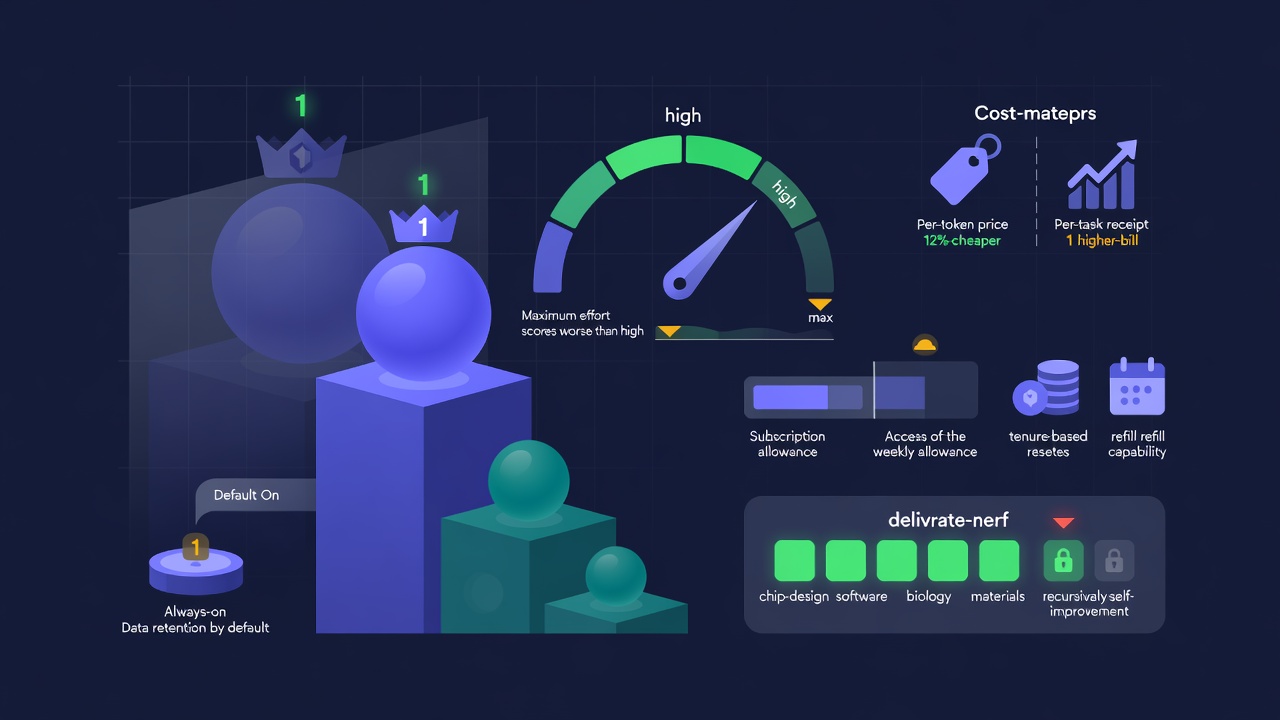
This is the finding that defined launch day. On several benchmarks, Fable 5.2 scores higher at high effort than at xhigh or max. Vals found "high" was the best-performing effort, above both xhigh and max. Theo saw the same pattern in Artificial Analysis's code-only view, where the gap to other models also narrowed at the top setting. The dip shows up only on Fable, not on Opus or Sonnet, which is what makes it strange rather than noise.
The reactions were blunt. "Don't use Fable 5.2 Max," wrote Yuchen Jin. Theo offered "don't use max reasoning" as a plain-English reading of Anthropic's own guidance. Cursor warned that effort levels behave differently from 5.1 and told users to start at the default rather than carry over old settings. If you are paying by the token, cranking effort to max can cost you more and score you less, which is not how any of this is supposed to work.
The cost math is the real story
Lower per-token prices do not mean lower bills. At max effort, Artificial Analysis clocked Fable 5.2 at roughly $26.50 per task, about 2.6 times Opus 5.5 at $10 and 2 times Fable 5.1, because it burns far more tokens. SemiAnalysis saw the same thing on its GDPx eval: cost per task rose 31 percent, from $67 to $88, even with the 20 percent cheaper token price, because Fable generates hundreds to thousands of test cases where older models stopped at about 20 and spawns subagents more eagerly.
The efficient path is high or xhigh, not max. There, Fable scores 62 using about 98,000 output tokens per task against 173,000 for Opus 5.5 at max. That is a genuine efficiency win. It just lives at the middle of the dial, not the top.
Why it matters
If you buy AI by the task, the move is to run Fable 5.2 at high effort for hard, long-horizon work and route everything else to a cheaper model. The default-medium setting and the "don't max it" advice both point the same way: this is a heavy model you reach for deliberately, not a daily driver. Anthropic's own staff said as much, suggesting Opus 5.5 for well-specified tasks and Fable for ambiguous, exploratory work where you don't yet know the full shape of the answer. Deciding which model handles which task is exactly the routing problem, and it is why running everything through one app with multiple models beats paying full freight on the most expensive one. For the raw per-task numbers against Opus, our subscription-value breakdown has the fuller picture.
The subscription limits are brutal
Theo analyzed 1.1 million logged requests on a $200 Ultra plan. The plan yields about $15,000 a month of Opus 5.5 at API rates but only about $3,000 of Fable 5.2. On top of that, Fable can consume at most 50 percent of the weekly limit, so people who want to use only Fable effectively lose half their allowance. Anthropic softened the landing with tenure-scaled "resets": Ultra and Team Premium get 1 to 3 Fable-only resets depending on how long they have subscribed, usable until March 8, and Pro and Team Standard get a one-week trial capped at half the weekly limit plus one reset.
There is also a data-retention string attached. Fable 5.2 requires data retention by default so Anthropic's safety classifiers can run, with zero-data-retention available only to eligible enterprise customers. The caps and the retention default fit a pattern regular Claude users already know from the recent limits changes. The intelligence is frontier. The access is rationed.
What Anthropic is holding back
The naming is a signal. Several people read "5.2 instead of 5.5" as Anthropic quietly saying this is an incremental release. SemiAnalysis called it "a marginal improvement, incomparable to the original Mythos release, and likely far behind what Anthropic has internally," and the system card states the company's most capable model stays internal. Fable 5.2 also ships with a deliberate nerf on recursive self-improvement and AI-research tasks: Dylan Patel's domain breakdown shows it is much better at chip design, software engineering, biology, and materials science, but not better at finance, legal, quant trading, hardware design, or the one capability Anthropic chose to hold down on purpose. The launch also landed the same day Anthropic's IPO roadshow started, which colored a lot of the commentary.
Video: an honest Fable 5.2 review
A hands-on walkthrough of the release, what improved over 5.1, and whether the hype holds up.
FAQ
Is Claude Fable 5.2 better than Opus 5.5?
On raw benchmarks, yes. Fable 5.2 scores 65 on Artificial Analysis's Intelligence Index against 59 for Opus 5.5 at max. But Opus 5.5 is cheaper per task and faster for day-to-day work, and some Anthropic staff still prefer it for well-specified jobs. Fable's edge is on big, ambiguous, long-running tasks.
Should I use Fable 5.2 at max effort?
Mostly no. On several benchmarks, max and xhigh score lower than high while costing more, a dip that shows up only on Fable. Start at the default and reserve higher effort for the hardest problems. Our guide on cutting coding-agent costs with model routing covers how to pick the right setting per task.
Why is Fable capped at half my weekly limit?
Fable is an expensive model to serve, so Anthropic limits it to 50 percent of the weekly usage cap on consumer plans and hands out a small number of Fable-only resets scaled by how long you have subscribed. If you mostly want Fable, a single-subscription setup may not be the cheapest way to get it.
Sources
- @claudeai - official launch of Fable 5.2 and Mythos 5.2
- Anthropic - Claude Fable and Mythos 5.2 announcement
- @ArtificialAnlys - benchmarks, pricing, and cost-per-task
- @kimmonismus - vendor-reported headline numbers
- @marktenenholtz - "the model that underlies" shared-base-model note
- @Yuchenj_UW - "Don't use Fable 5.2 Max"
- @theo - $15K of Opus vs $3K of Fable on a $200 Ultra plan
- @SemiAnalysis_ - GDPx #1 and the 31% cost-per-task rise
- @dylan522p - domain-by-domain breakdown and the RSI nerf
- @ClaudeDevs - tenure-scaled Fable resets
Further reading
Try all the models mentioned in this article
Admix gives you GPT-5, Claude, Gemini, and 300+ AI models in one app. Compare responses side by side. Try it for 7 days for $1.99.
Try Admix for $1.99