Anthropic Filed to Go Public as "ANT". Its S-1 Shows $16.3B in Revenue and an 85% Gross Margin.
Quick verdict
Anthropic filed its S-1 on Monday and plans to list on Nasdaq under the ticker "ANT." The filing shows a company that crossed into operating profit while carrying enormous compute obligations that stretch into the next decade. Revenue went from $41M in 2023 to $16.3B in the first half of 2026. Q2 operating profit was $974M. Gross margin hit 85% for the half. If you have been wondering whether the Claude business is real or propped up by investor cash, the answer in these pages is that it is real, and it is growing at a rate that is hard to find a comparison for.
For people who pay for AI, the more useful question is what a public Anthropic does to pricing. The filing has hints, and most of them point the same direction.
What the filing actually shows
Anthropic filed publicly on Monday at around 9am ET. The company announced it with the usual registration disclaimer, and the EDGAR link went up shortly after. The IPO had been expected around November 9.
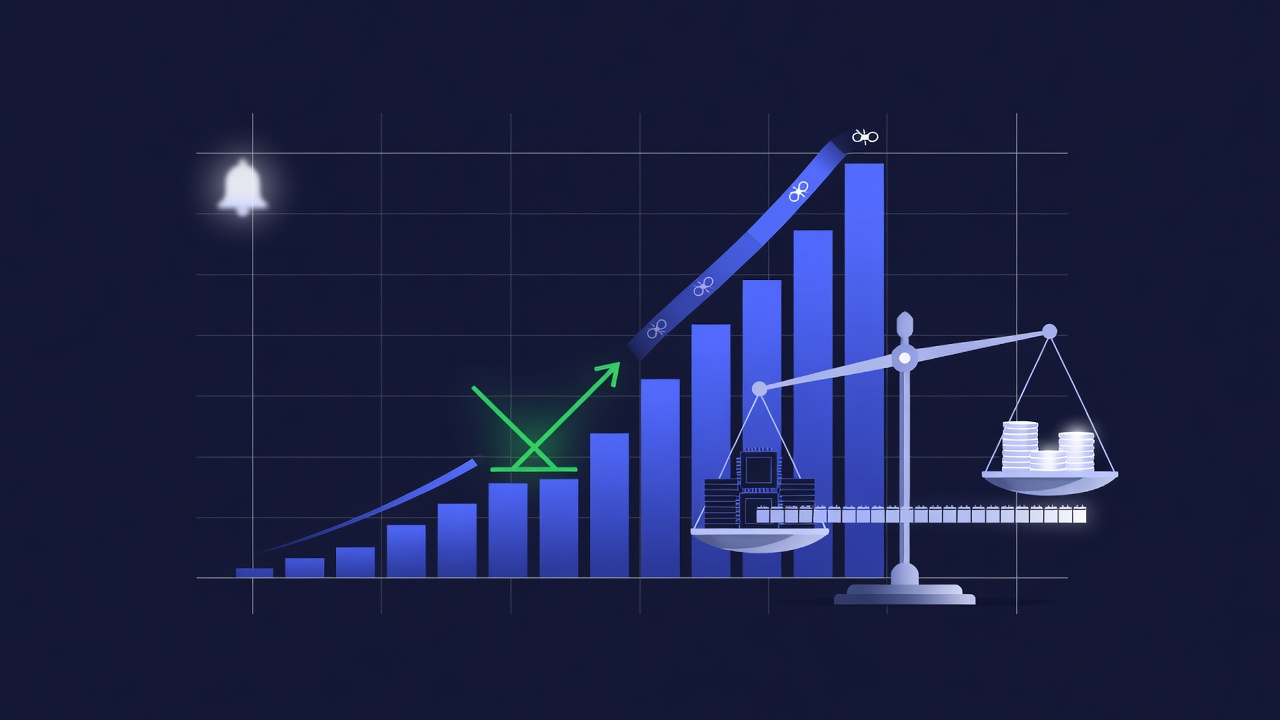
The revenue curve is the headline. From $41M in 2023 to $16.3B in H1 2026 is roughly 14x year over year. Q2 alone was $11.6B, up 1,368% from the year before. Q2 operating profit landed at $974M, and operating cash flow for the half was positive $3.9B.
The scary-looking number is the $80.7B H1 net loss. That is not an operating loss. It includes $81.1B of non-cash charges tied to financial instruments, mostly the mark-to-market on convertible notes from Amazon and Google. Those notes convert at $2 to $5 per share against a Series H price near $59, so accounting rules force a huge paper liability onto the books. It is not money going out the door.
The gross margin story
Jamin Ball pulled the gross margin trajectory straight from the filing, and it is the clearest signal of the business turning:
| Period | Gross margin |
|---|---|
| 2023 | 37% |
| 2024 | (95%), negative |
| 2025 | 40% |
| H1 2025 | 12% |
| H1 2026 | 85% |
Going from a 95% negative margin to 85% positive in two years is the part that made SemiAnalysis call this "likely the most efficient scaling of a business in the history of capitalism." Their math: Anthropic raised $141.1B in aggregate, holds $112.4B in cash plus $19.3B in short-term investments, and has an implied lifetime burn of about $9.7B. Austen Allred puts the burn closer to $9.4B. The derived cash figures do not perfectly agree across accounts, so treat the exact decimals with some caution, but the shape is not in dispute.
One number worth keeping in mind: Aymeric Roucher derived $2.08 of revenue for every $1 of compute, which implies under a year of payback on the hardware. That is the engine behind the margin flip.
The $120.5B that sits against all of it
The other half of the filing is the obligation side. Anthropic disclosed non-cancelable compute commitments running deep into the next decade, including up to $120.5B for NVIDIA-powered compute through SpaceXAI under agreements extending into 2029. We wrote about the SpaceX compute partnership when it first raised Claude Code limits, and the S-1 shows how large that bet really is.
This is the tension Sarah Guo flagged in her first read: revenue is consumption-based and can move month to month, while the compute obligations are fixed and stretch out for years. The filing also disclosed that Anthropic recently delayed pre-training of a new frontier model, which some read as prudent capacity management and others read as a crack in the "scale forever" story.
Why this matters if you pay for AI
A public company answers to shareholders every quarter. That changes the incentives behind the pricing you see on your bill.
First, the circular-revenue question is real. About 48% of H1 2026 revenue, roughly $7.8B, flowed through the Bedrock, Vertex, and Azure marketplaces, up from 11% in 2023. The marketplace fees sit in sales and marketing rather than cost of revenue, so they never touch that clean 85% gross margin. As one analyst put it, the hyperscalers get paid twice, once for the compute and again for distribution. A chunk of the revenue is also AI companies buying AI from each other, which is worth remembering when you read the growth rate.
Second, watch how price cuts get reported. Several readers of the S-1 noticed a falling "token price index" and called it a round of price cuts. That is mostly a mix effect from the Haiku and Opus 5.5 launches, not a deliberate reduction, and the filing does not break out margins by model. If you plan a budget around "Anthropic keeps cutting prices," you are reading the chart wrong. Our take on where AI pricing is heading goes deeper on why the headline per-token number keeps falling without your actual bill dropping.
Third, profitability cuts both ways for buyers. A lab that is already operating in the black has less reason to subsidize usage to grab market share, and more reason to protect margin once it is public. The flip side is that a solvent Anthropic is far less likely to yank a model or gut a plan overnight to save cash, which has been a real risk with less stable providers.
Video: breaking down the filing
If you want the numbers walked through rather than listed, this breakdown covers the revenue, the burn, and the compute commitments in one pass.
The skepticism is earned
The bull case is strong, but a few things deserve a raised eyebrow. Consumption revenue against decade-long fixed obligations is a genuine mismatch, and a single bad quarter of demand hits the revenue line without touching the compute bill. Polymarket's expected IPO closing valuation barely moved after the filing, slipping from about $2.1T to $2.0T, so the market did not treat the numbers as a surprise to the upside.
There is also the governance detail. A Public Benefit Fund takes 5% of shares, founders pledged 80% of their equity, and public shareholders get limited influence. That is consistent with Anthropic's mission framing, and it also means the people buying "ANT" are along for a ride they do not steer.
FAQ
When will Anthropic actually IPO?
The filing went public on a Monday with the listing expected around November 9 under the ticker "ANT" on Nasdaq. An S-1 is the registration step, not the trade date, and timing can still move.
Is Anthropic really profitable?
On an operating basis, yes for Q2, with $974M of operating profit and positive operating cash flow for the half. The large net loss on the filing is a non-cash accounting charge from convertible notes, not an operating loss.
Will going public make Claude more expensive?
Not directly, but a public company has more pressure to protect margin and less reason to subsidize usage. The falling per-token "price index" in the filing is mostly a model-mix effect, not a real cut. If you want to keep your AI spend flat, routing across providers through an aggregator gives you more control than betting on any one lab's prices.
How does this compare to OpenAI and Google?
The S-1 is the first time anyone outside the lab has seen audited Anthropic financials at this detail, which makes direct comparison easier. Our breakdown of the three frontier labs covers how the businesses actually stack up.
Sources
- @AnthropicAI - announcing the S-1 filing
- @rishdotblog - the EDGAR filing link
- @kimmonismus - revenue, profit, and compute commitment figures
- @jaminball - gross margin trajectory from the filing
- @SemiAnalysis_ - capital efficiency and implied burn
- @AymericRoucher - revenue per dollar of compute
- @Bensign - cloud marketplace distribution and fees
- @saranormous - commitment mismatch and first-read notes
- @cis_female - on misreading the token price index as price cuts
- @TheEthanDing - Polymarket's muted valuation move
Further reading
Try all the models mentioned in this article
Admix gives you GPT-5, Claude, Gemini, and 350+ AI models in one app. Compare responses side by side. Try it for 7 days for $1.99.
Try Admix for $1.99