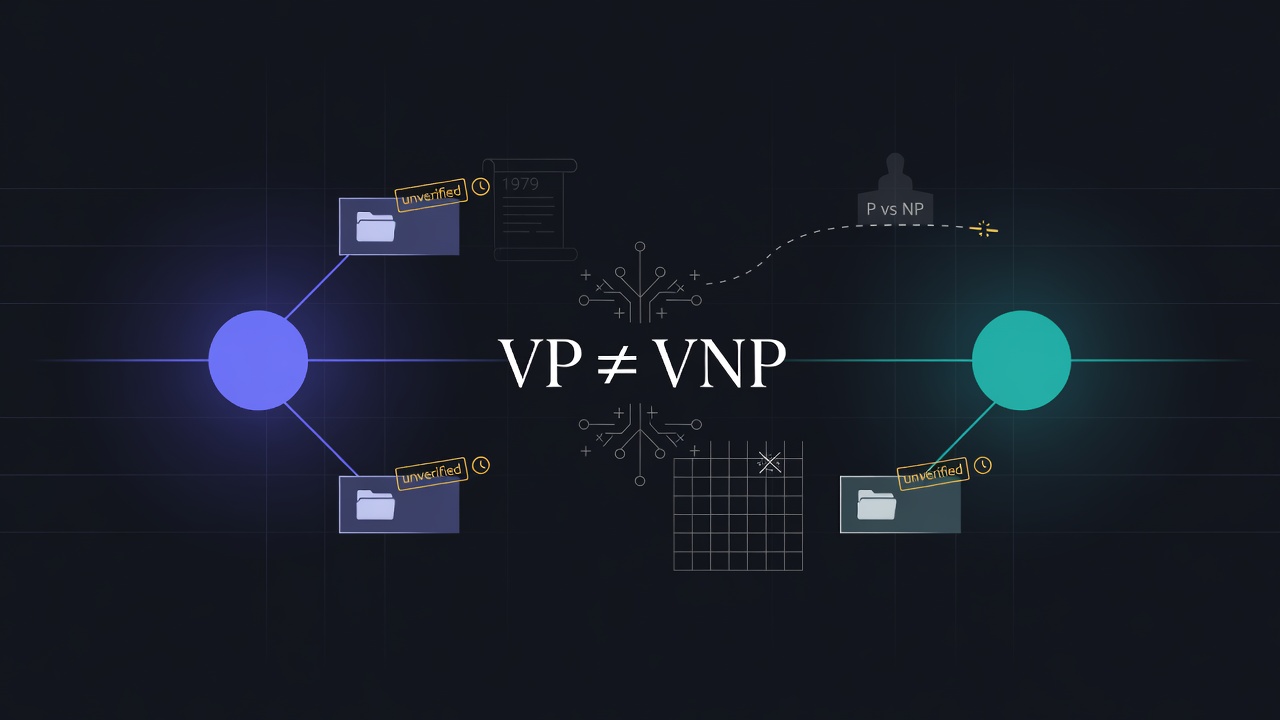
Anthropic and OpenAI Both Posted an AI Proof of VP ≠ VNP Within Days of Each Other
Quick verdict
Over a single quiet week, Anthropic and OpenAI both surfaced proofs of the same obscure result: VP ≠ VNP, the algebraic analogue of P vs NP. Each proof appears to have come from an internal research model, each landed in a code repo rather than a paper, and neither lab put out an announcement. It is a genuine signal about where AI-for-math is heading. It is also unverified, and it does not settle P vs NP. Read it as two labs showing their hand, not as a closed case.
What actually happened
The sequence, as far as anyone outside the labs can reconstruct it:
- An Anthropic GitHub repo reportedly contained a proof, attributed to an internal Claude research model, that VP ≠ VNP over every field. The pointer circulated on X before any blog post existed.
- OpenAI then posted its own proof of the same separation and noted the result was "obtained on November 6, 2026," implying it had been sitting unreleased for weeks.
- Neither lab named the model that produced the work, and neither published a formal writeup to go with the repo.
So the public artifact in both cases is code and a draft, not a reviewed paper. That matters for how much weight to put on either claim, which we will get to.
What VP ≠ VNP even means
VP versus VNP is a question Leslie Valiant posed in 1979. It is the algebraic world's version of P versus NP. Instead of asking whether every quickly-checkable decision problem can be solved quickly, it asks whether every polynomial that is easy to describe is also easy to compute with a small arithmetic circuit, the kind built from additions and multiplications.
The classic test case is the permanent of a matrix, which looks almost identical to the determinant but is believed to be far harder to compute. Proving VP ≠ VNP means showing that polynomials like the permanent have no small circuits, over every field, not just over one convenient number system. That "every field" clause is what makes the claimed result strong, and also what makes it hard to check at a glance.
What this is not
This is the part that gets flattened in the hype, so it is worth stating plainly. A proof of VP ≠ VNP does not prove P ≠ NP. The algebraic separation lives in a different model of computation. Settling P versus NP still needs general Boolean circuit lower bounds, which nobody has, AI or otherwise. One analysis making the rounds put it directly: the result, if real, does not imply P ≠ NP.
It is also not peer-reviewed. A proof that compiles in a formal system is strong evidence; a PDF in a repo with no independent check is a claim. Several commentators pointed out that both labs appear to be sitting on unreleased results and floating unconfirmed rumors of cryptography breakthroughs alongside them. That part is opinion, and should be treated as such until an artifact shows up that outsiders can verify.
Why the duel matters more than the math
You are never going to use a VP ≠ VNP proof. The reason to pay attention is the shape of the week itself.
Two labs, independently, pointed internal models at a 45-year-old open problem in algebraic complexity and both came back with something they were confident enough to post. Days earlier an Anthropic mathematician had claimed a Claude-assisted Riemann Hypothesis proof, and in September OpenAI floated a Navier-Stokes result from an unreleased model. The cadence is the story: frontier-math claims are now arriving monthly, from more than one lab, on problems that sat untouched for decades.
The honest caveat rides along with it. These wins are jagged. A model can grind through mechanical casework at a scale no human would attempt and still fumble something a careful undergraduate would catch. That gap is the whole experience of using these tools in 2026, and it is the practical argument for not routing your work through a single model. The same reasoning that says "verify the proof" says keep more than one model within reach rather than trusting one lab's output on faith.
Video: VP, VNP, and the P vs NP connection
A short primer on what the algebraic complexity classes are and how they relate to the famous P versus NP question.
FAQ
Did AI prove VP ≠ VNP?
Not confirmed. Anthropic and OpenAI each posted a proof of the separation, apparently generated by internal research models, but both live in code repositories without a reviewed paper or independent verification. The claims are plausible and striking, not settled.
Does this mean P ≠ NP is solved?
No. VP ≠ VNP is the algebraic analogue of P vs NP, not the same problem. Proving it does not prove P ≠ NP, which still requires Boolean circuit lower bounds that remain open.
Why did both labs post the same result at once?
Nobody has explained it. The most likely reading is that both were sitting on internal math results and one lab's pointer leaking prompted the other to post. It fits a broader pattern of labs racing to show frontier-math capability, which you can see across this year's run of AI-assisted proofs.
Can I trust AI on math like this?
On narrow, formally checkable problems, the evidence that models can contribute real results keeps building. The catch is jaggedness: strong where a machine can check the answer, unreliable almost everywhere else. For anything that matters, verify the output and avoid depending on one model, which is the case for comparing across tools.
Sources
- @kimmonismus - Anthropic repo reportedly holds a Claude proof of VP ≠ VNP over every field
- @BlancheMinerva - pointer to the proof repo
- @AndrewCurran_ - OpenAI posts its own proof, says it was obtained November 6
- @ZhihuFrontier - the result does not imply P ≠ NP
- r/singularity - Anthropic's VP ≠ VNP claim, with a link to the repo paper
Further reading
Try all the models mentioned in this article
Admix gives you GPT-5, Claude, Gemini, and 300+ AI models in one app. Compare responses side by side. Try it for 7 days for $1.99.
Try Admix for $1.99