Qwen4-Max Is Cheaper and Faster, but It Scored 43 Where Opus Scores 65
Quick verdict
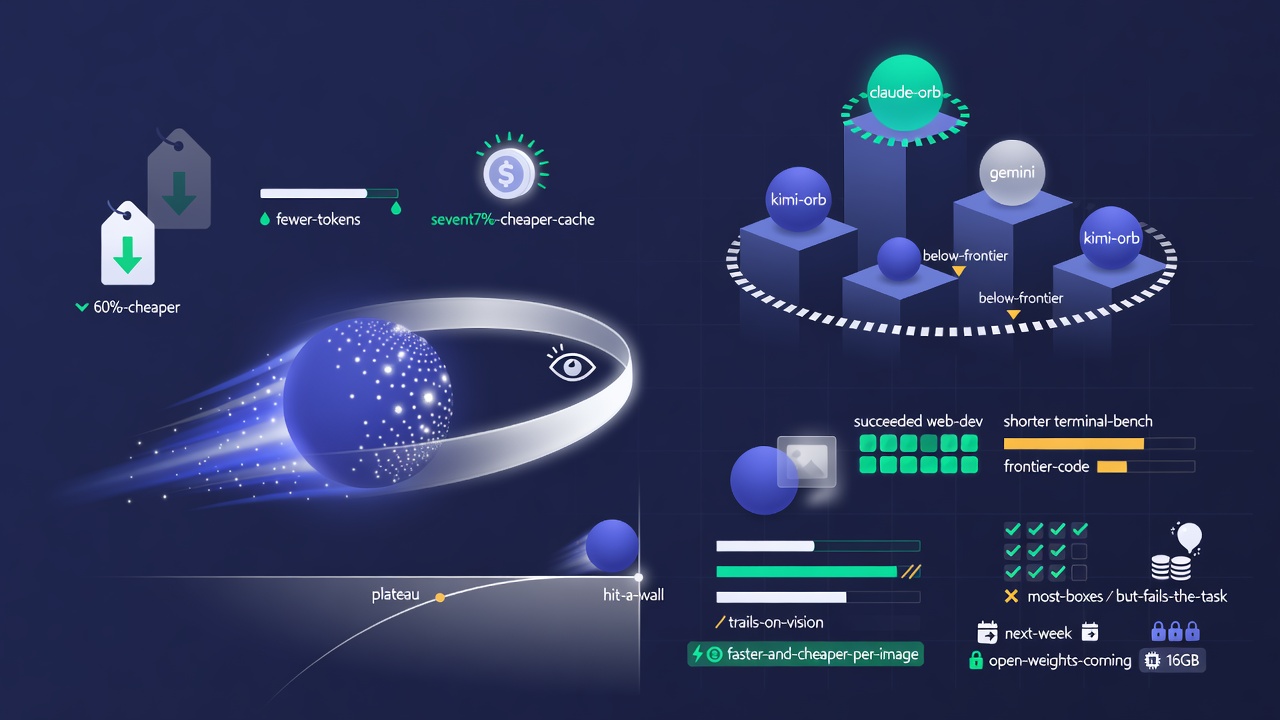
Alibaba launched Qwen4-Max, a new flagship built on a fresh mixture-of-experts architecture with native vision and a 1M-token context window. The pitch is efficiency: Alibaba says it uses up to 50% fewer tokens than Qwen3.8-Max and cut average cost per task more than 60% in internal evals, with API pricing at $1.50 per million input tokens and $4.50 per million output. The catch is the scoreboard. Artificial Analysis puts it at 43 on its Intelligence Index, 9 points above the last Max model but well under Claude Opus 4.5 at 65 and Gemini 3 Pro at 60, and 3 points below Kimi K3.1 Pro. If you want a cheap, fast agentic model and can live below the frontier, this is a real option. If you want a model that tops the charts, it is not that.
What actually shipped
One flagship, with smaller open-weight siblings promised to follow. Qwen4-Max is API-only for now and leans entirely on being cheaper per unit of work rather than smarter per token.
- Pricing is $1.50 per million input tokens and $4.50 per million output, with implicit cache hits at $0.075 per million, which Alibaba says is 70% cheaper than Qwen3.8-Max on cached input.
- Artificial Analysis measured $3.27 per task, roughly 3x less than the previous Max model and about 11% under Kimi K3.1 Pro. Output tokens per task dropped 39%, from around 171k to 105k, which is where most of the savings come from.
- It is live on the QwenCloud API, Qwen Studio, QwenWork, Qoder, and OpenRouter. Hugging Face Inference Providers now routes through OpenRouter too, so the plumbing is already in place.
- Smaller Qwen4 models are coming. Unsloth says a Qwen4-27B should run in 16GB of RAM, though commenters note that implies heavy quantization and an unclear context length.
- On the index itself, HLE-Diamond rose from 24% to 45% and AA-Briefcase reached 1686 Elo, so the reasoning gains over Qwen3.8-Max are genuine even if the absolute number trails the top labs.
The coding and agent picture is mixed. On Code Arena it placed #6 in WebDev at 1750, up 74 points over its predecessor, and #6 in Image-to-WebDev, just above Claude Opus 5 and GPT-6 Sol. On Agent Arena it ranks #14 overall and first among Chinese models, with a +7.5% net score across 14.7k sessions. But it trails Kimi on Terminal-Bench 4.0 by a wide margin, 48% against 67%, and sits behind Tencent Hy4 on FrontierCode 2.0. Vals flagged a sharper problem on legal work: on the HLAB benchmark it got 95.7% of checklist items right but passed only 21.3% of full tasks, while burning 3.6x the output tokens. Getting most of the pieces right and still failing the task is a pattern worth testing for before you trust it on anything end-to-end.
Vision is the clearest weak spot. Roboflow called the model underwhelming on its independent VLM benchmark, with Google, OpenAI, and Anthropic now far ahead. The one bright side there is cost: at high reasoning effort it ran about 4.5x faster and 68% cheaper per image than Qwen3.8-Max, so it may still earn a place on high-volume, low-stakes image work where a frontier VLM is overkill.
Why it matters
The honest read is that Qwen4-Max is a value play, not a frontier play. @teortaxesTex argued the efficiency claims make it look like a next-generation "Flash" model and suggested Alibaba has "hit a wall," then added that it is very cheap and would make a good local model once the weights open. That tension is the whole story. A model that is 3x cheaper per task than its predecessor and still competitive with Kimi matters for anyone running agents at volume, where the bill is driven by token count and task count, not by whether you topped a leaderboard.
This is the same pressure the Chinese open labs have been applying all year, and it keeps landing on cost rather than raw capability. We traced the last Max release in Qwen3.8-Max opening its weights, and Kimi's side of the race in Kimi K3.1 Pro. The practical takeaway has not changed: the cheap tier is closing the gap on price faster than the paid frontier is getting cheaper, which is exactly why routing work across models beats committing to one. We walk through that in cutting AI coding agent costs with model routing.
For most readers the move is not "switch everything to Qwen4-Max." It is to send the high-volume, cost-sensitive work to a model like this one and keep the paid frontier for the tasks where the benchmark gap actually shows up, like hard coding and vision. That means running several models side by side rather than betting on a single lab, which is the case we make in the best app for running multiple AI models. Where the whole open ecosystem sits right now is in open-source AI models in 2026, and how the Chinese labs keep climbing the usage charts is in Chinese open models on OpenRouter.
Video: Qwen4-Max put to the test
This runs Qwen4-Max against Opus 5.5 on real tasks and checks whether the 3x cheaper pricing holds up once you account for how many tokens it spends.
FAQ
How much does Qwen4-Max cost?
API pricing is $1.50 per million input tokens and $4.50 per million output, with implicit cache hits at $0.075 per million. Artificial Analysis measured about $3.27 per task, roughly 3x less than Qwen3.8-Max and about 11% cheaper than Kimi K3.1 Pro, mostly because it spends 39% fewer output tokens per task.
Is Qwen4-Max better than Opus 4.5 or Gemini 3 Pro?
No, not on the benchmarks that exist today. It scored 43 on Artificial Analysis's Intelligence Index against 65 for Claude Opus 4.5 and 60 for Gemini 3 Pro High. It is a value model. On the benchmarks that define the frontier right now, it is not close.
Can I run Qwen4-Max locally?
Not yet. The Max model is API-only for now. Alibaba says smaller Qwen4 models are coming, and Unsloth claims a Qwen4-27B should fit in 16GB of RAM, though that likely means aggressive quantization and a reduced context window. The weights for those smaller models had not landed at launch.
What is it actually good at?
Cheap, high-volume agentic and coding work where token cost matters more than topping a chart. It placed #6 on Code Arena WebDev and first among Chinese models on Agent Arena. It is weaker on hard terminal tasks, legal task completion, and vision, so test those yourself before relying on it. For where it fits among coding tools, see the best AI coding agents.
Sources
- @Alibaba_Qwen - Qwen4-Max launch, pricing, and efficiency claims
- @ArtificialAnlys - Intelligence Index 43, cost per task, token counts
- @arena - Qwen4-Max #14 on Agent Arena, top Chinese model
- @skalskip92 - Roboflow VLM benchmark, vision trails Google, OpenAI, Anthropic
- @teortaxesTex - the "hit a wall" critique
- @UnslothAI - Qwen4-27B reported to run in 16GB RAM
- @OpenRouter - Qwen4-Max available on OpenRouter
- r/singularity - the 43 score reaction and competitor context
Further reading
Try all the models mentioned in this article
Admix gives you GPT-5, Claude, Gemini, and 300+ AI models in one app. Compare responses side by side. Try it for 7 days for $1.99.
Try Admix for $1.99