Jev Kicked Off a Rush Toward Models That Decide Instead of Generate
Quick verdict
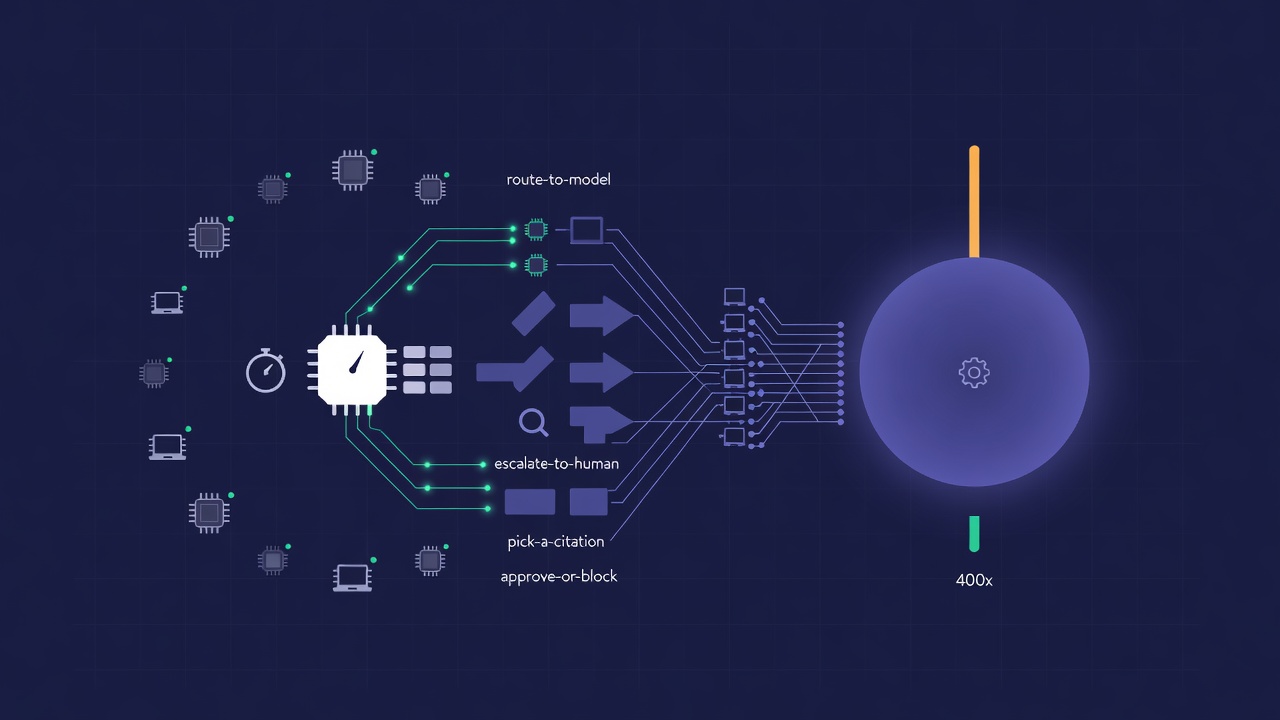
The loudest technical thread this week was not a new chatbot. It was Jev, a model that does not write text at all. It reads a request and returns a calibrated probability, which makes it a cheap way to decide things an LLM was doing by default: which model to route to, whether to escalate, which citation to trust, whether a support ticket needs a human. The pitch is speed and price, roughly 400 times cheaper to score than the setup it replaces, running in tens of milliseconds. Within days people shipped open copies that anyone can run locally, some small enough for a laptop. If you pay for AI by the token, the interesting part is that a lot of the decisions burning those tokens do not need a generative model to make them.
What Jev actually is
Jev is a discriminative model, not a generative one. Instead of producing a sentence, it scores an input against a set of typed options and hands back a probability it is confident about. @ankrgyl said it landed as an eval model in Braintrust with about 400x lower scoring cost than the prior approach. @gabepereyra listed the use cases it is built for: routing, citation selection, escalation, and legal-ops decisions, all cases where a well-calibrated probability beats a paragraph of prose.
The framing that got people talking is System 1 versus System 2. An LLM is the slow, deliberate reasoner. Jev is the fast reflex. @hxiao argued it could pull tool calling, routing, and MCP-style decisions back from small generative models toward discriminative ones, and @signulll pushed the idea toward a near-zero-cost, on-device judgment layer for things like notifications, UI adaptation, and sensor-driven calls. The common thread is a control plane, not a conversation.
The open clones landed almost immediately
What made this more than a product launch is how fast the ecosystem reproduced it. @madiator released Bespoke Nimble, an open recipe built from a LoRA fine-tune of Qwen3.5-9B using synthetic contrastive data and constrained decoding. On its own eval the base Qwen went from 66% to 90%, against 93% for Jev, at a reported 100ms on an H100. At the tiny end, @jaredpalmer shipped Kev-0.5B, a Jev-like model based on Qwen2.5-0.5B small enough to run on a MacBook Pro.
The community went further on r/LocalLLaMA. One team released Laya, a 421M-parameter decision model built on a ModernBERT encoder, claiming 38.4ms latency against Jev's roughly 400ms average and higher accuracy on intent routing, moderation, and fact checking. Another posted Cactus Needle 3, an 8 to 29MB sliceable automation model that runs CPU-only and scored 86.0 on Mobile Actions against DeepSeek V4 Flash at 88.4. When a category goes from one proprietary model to a spread of open ones this quickly, it usually means the recipe is not that hard to copy.
Where it is already useful
The early integrations point at browser and computer-use work rather than chat. @levie demoed Jev sorting Box incident reports into escalation paths. @ndrezn ran browser use with LangChain plus Jev and found it strong on structured tasks. @cline shipped a plugin that gives Jev a browser inside Cline, and @hwchase17 called browser use the best Jev application he had seen so far. The pattern is a fast model making the many small yes/no and which-path calls inside an agent loop, leaving the expensive model for the reasoning that actually needs it.
The honest caveat
Not everyone is sold, and the skeptics are making the right point. @abacaj noted that most of the demos lead with speed rather than quality, and that there is still no standard benchmark for this category, which makes the head-to-head numbers hard to trust. @MParakhin pointed out the generational split in the reaction: people who arrived after ChatGPT treated a fast classifier like a revelation, while machine-learning veterans who spent years on discriminative models were more puzzled by the excitement. Both things can be true. The idea is old, and the packaging, calibrated typed decisions as a drop-in layer next to your LLM, is what is new.
Video: small models are eating the easy decisions
Background on why teams are pushing work off large models onto small specialized ones, which is the same logic behind the Jev wave.
What it means if you pay for AI
You will not chat with a decision model, so this is not a subscription you go buy. It matters because of where the cost in AI actually sits. A big share of an agent's token bill goes to routing and gating decisions, not to the final answer, and those are exactly the calls a cheap discriminative model can take over. That is the same instinct behind routing coding-agent work across models by cost and behind Cursor's router picking a cheaper model when it can. If the routing itself gets nearly free, the case for running everything through one AI aggregator and sending each task to the right model only gets stronger.
FAQ
What is a decision model like Jev?
It is a discriminative model that returns a calibrated probability over a fixed set of options instead of generating text. That makes it a fast, cheap layer for routing, escalation, moderation, and tool-selection decisions that an LLM would otherwise handle at much higher cost.
Can I run one of these myself?
Yes. Open versions arrived within days, including Kev-0.5B, which runs on a MacBook Pro, and Cactus Needle 3, an 8 to 29MB CPU-only model. Our guide to open-source AI models covers where small local models fit alongside the frontier ones.
Does this replace my LLM?
No. The pitch is a System 1 reflex that sits next to your System 2 reasoner, taking the fast decisions so the expensive model only runs when the work needs real reasoning. See our rundown of the best AI coding agents for where that split shows up in practice.
Sources
- @ankrgyl - Jev in Braintrust at ~400x lower scoring cost
- @gabepereyra - calibrated-probability use cases: routing, citation, escalation, legal ops
- @hxiao - pulling tool calling and routing back to discriminative models
- @madiator - Bespoke Nimble, an open Jev recipe on Qwen3.5-9B
- @jaredpalmer - Kev-0.5B runs on a MacBook Pro
- @abacaj - demos emphasize speed over quality, no standard benchmark yet
- r/LocalLLaMA - Laya, a 421M open decision model
- r/LocalLLaMA - Cactus Needle 3, an 8-29MB CPU automation model
Further reading
Try all the models mentioned in this article
Admix gives you GPT-5, Claude, Gemini, and 350+ AI models in one app. Compare responses side by side. Free to start.
Start free on Admix