Jensen Huang Is Out at Nvidia: What's Confirmed, What Isn't, and Why It Touches the AI You Use
Quick verdict
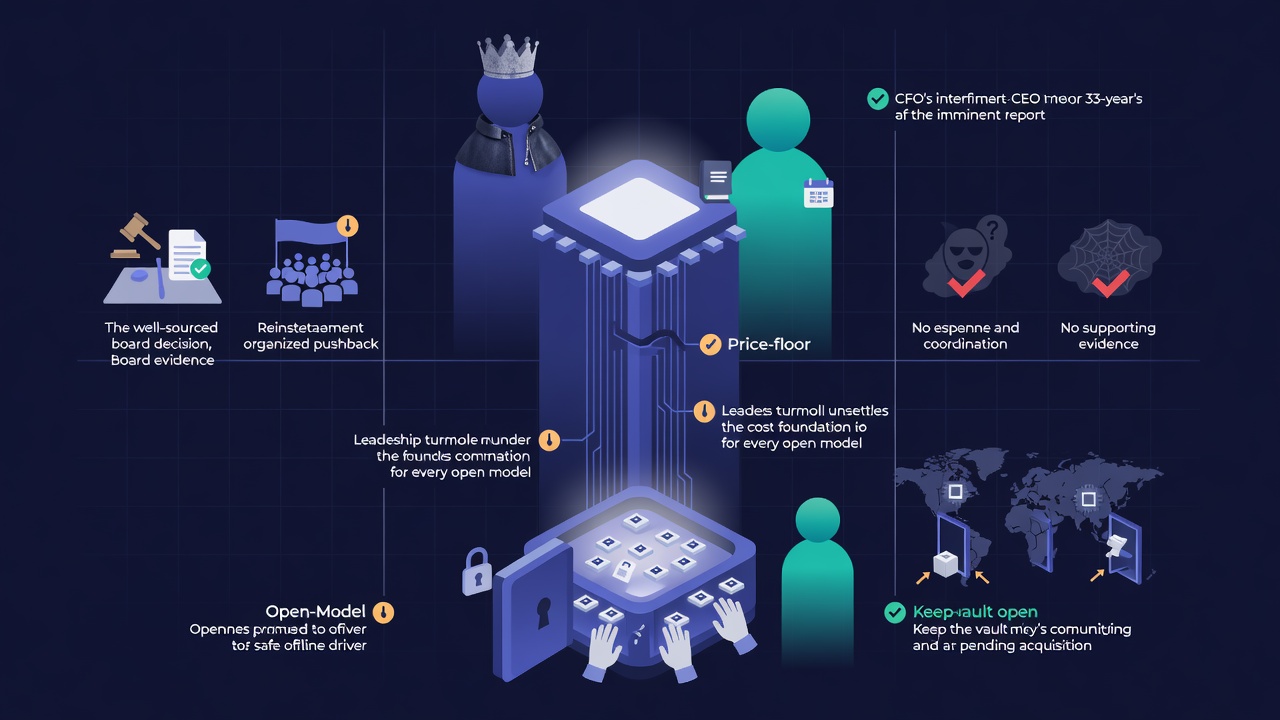
Jensen Huang, who ran Nvidia for 33 years and turned it into the company that supplies the chips behind nearly every AI model, has resigned. Nvidia's board confirmed the exit after a meeting, and CFO Colette Kress steps in as interim CEO with her first earnings report due Tuesday. The reported trigger is personal rather than strategic, which is unusual for a departure this large, and a lot of what is circulating online, including a spy allegation and a conspiracy theory, is still unproven. For anyone who uses AI rather than trades the stock, the story that matters is not the gossip. It is that the single most important supplier in the industry just lost its founder-CEO in the middle of a pending deal to buy Hugging Face, the main home of open-weight models. That is the part worth watching.
What is actually confirmed
Strip out the noise and a short list of facts holds up across multiple outlets:
- Huang resigned after a board meeting, first reported by The Information.
- Colette Kress, Nvidia's longtime CFO, is interim CEO. Nvidia reports earnings on Tuesday, her first test in the role.
- Bloomberg reported that Nvidia's general counsel confronted Huang after a Financial Times story about an affair, and that Huang confessed. A second affair was reported by the New York Times.
- The Wall Street Journal reported that Kress had pushed back internally on billions in chip-financing guarantees and had halved Nvidia's financial backstop for OpenAI.
- WIRED reported that an internal employee post asking the board to reconsider drew more than 1,600 comments, most of them backing Huang's return.
- Elon Musk said publicly he would sign a petition to reinstate Huang, the single most-shared post of the day.
So the shape is clear. A board acted on a personal matter, an internal successor took over, employees pushed back hard, and a high-profile reinstatement campaign started almost immediately. Bryan Catanzaro, an Nvidia VP, publicly backed the board and Kress and called a circulating reinstatement letter that cited him a fake, so the company is not speaking with one voice.
What is not confirmed, and worth treating with caution
Two of the loudest threads do not have the evidence behind them that the confirmed facts do.
- The spy allegation has not held up. CNN reported that US intelligence still cannot prove that Alice Huang, an executive at the chip reseller Megaspeed, spied for China, and writer Brian Chau argued the national-security framing is unsupported by what has actually been shown. Treat it as an open question, not a finding.
- The coordination theory has nothing behind it. A viral Chinese-language post claimed that Anthropic, politicians, and the CIA coordinated to push Huang out, but it presents no verifiable evidence and should be read as rumor.
The reason to flag these is practical. A resignation this big pulls in a swarm of claims that get repeated until they feel settled. Right now the personal reporting is solid, the governance sequence is solid, and the espionage and conspiracy angles are not.
Why it matters for the AI you actually use
Nvidia is not just a stock here. It is the layer under the layer. The models you run in a chat app, the APIs your tools call, the open weights people fine-tune at home, almost all of it trains and serves on Nvidia hardware. A leadership shock at that company ripples outward in two ways that touch regular users.
First, pricing and supply. Nvidia's roadmap and its financing deals shape how much compute the labs can buy and how fast, which in turn sets the floor under what models cost to run. The WSJ detail about Kress trimming a multibillion-dollar OpenAI backstop is a hint that the new leadership may be more conservative about underwriting customers, and that kind of shift eventually shows up in what you pay. We dug into that mechanism in our look at how a GPU glut could crack AI pricing and where AI pricing is heading.
Second, open weights. This is the sharper one.
The Hugging Face problem
Nvidia had agreed to buy Hugging Face, the platform that hosts the open-weight models and datasets a huge part of the community depends on. We covered that deal when it broke, in Nvidia is buying Hugging Face for $12.9B. The pitch at the time was that the platform would stay open and that you would not need Nvidia compute to build on it.
The person who made that promise is now gone. That is why, within hours of the news, people who maintain uncensored and abliterated models were telling others to mirror anything important before any ownership or policy shift. Hugging Face CEO Clément Delangue said he would keep fighting for open-source AI, and Thomas Wolf, the company's co-founder, said Nvidia insiders were urging the team to keep building in the open. Reassurance from a company that is about to be acquired tends to land as a warning, and a lot of the community read it that way.
For someone who runs more than one model, or who values having open options next to the closed frontier, the health of that hub is not abstract. It is where a big slice of model choice lives. A central distribution point for open weights changing hands, right as the executive who vouched for its independence walks out, is a real reason to pay attention. It is also a reminder of why keeping your tools separate from any one lab or chip vendor matters, which is the whole idea behind running several models through one neutral app instead of betting on a single provider.
The export-control backdrop
None of this happened in a vacuum. A New York Times op-ed by former official Chris McGuire, summarized widely, laid out the policy mess around Nvidia's China business: Megaspeed reportedly smuggled $7B of Nvidia chips into China, more than $60B in AI chips likely flowed through Singapore, Malaysia, and Thailand across 2025 and 2026, and the Commerce Department reportedly added no new names to its entity list in more than a year. SemiAnalysis estimated Nvidia earns roughly $7M in profit per megawatt when Chinese labs rent its compute. Whether or not the specific allegations around Huang hold up, the company was already sitting at the center of a hard fight over where its chips end up. For more on how that pressure shapes which models reach the rest of us, see our piece on China, export controls, and open weights and our rundown of the big labs.
Video: Jensen Huang resigns as Nvidia CEO
A short news summary of the resignation and the handover to Colette Kress, for the core facts without the speculation.
FAQ
Who is running Nvidia now?
Colette Kress, the company's CFO since 2013, is interim CEO. Her first big moment in the role is Nvidia's earnings report on Tuesday, which will be watched closely for any change in tone on customer financing and China.
Is the spy allegation against the Huang family proven?
No. CNN reported that US intelligence has not been able to prove the claim involving Alice Huang and Megaspeed. The affair reporting is well-sourced, but the espionage angle and the broader coordination theories remain unverified.
Does this change the price of the AI tools I pay for?
Not overnight. The link runs through compute: Nvidia's pricing and financing decisions set the cost floor for the labs, and new leadership that is more cautious about underwriting customers could nudge costs over time. If keeping your AI spend in check is the goal, our guide to free versus paid AI is a better starting point than watching chip headlines.
What happens to Hugging Face and open models?
The acquisition was still pending at the time of the resignation, and nothing about open-model access has changed yet. The concern is governance: the executive who promised to keep the platform open is gone, so the community is mirroring important models as a precaution while the deal plays out.
Sources
- @_pheebini - The Information: Huang resigned after a board meeting
- @kimmonismus - succession, earnings timing, and the Bloomberg/NYT/WSJ reporting
- @kimmonismus - WIRED on the internal reinstatement post and 1,600+ comments
- @ctnzr - Nvidia VP Bryan Catanzaro backs the board and calls a reinstatement letter fake
- @elonmusk - says he would sign a reinstatement petition
- @brianchau57 - argues the national-security framing is unsupported
- @AlecStapp - summary of the NYT export-control op-ed and smuggling claims
- SemiAnalysis - profit per megawatt on Chinese compute rentals
- @superalesha - open-model maintainers on Hugging Face's uncertain future
- @Thom_Wolf - Nvidia insiders urging Hugging Face to keep building in the open
- TechCrunch - Hugging Face CEO vows to keep fighting for open-source AI
- WIRED - Nvidia employees petition for Huang's return
- r/LocalLLaMA - resignation and Kress succession thread
Further reading
Try all the models mentioned in this article
Admix gives you GPT-5, Claude, Gemini, and 300+ AI models in one app. Compare responses side by side. Try it for 7 days for $1.99.
Try Admix for $1.99