China Floats Export Controls on Big AI Models, but Open Weights Get a Pass
Quick verdict
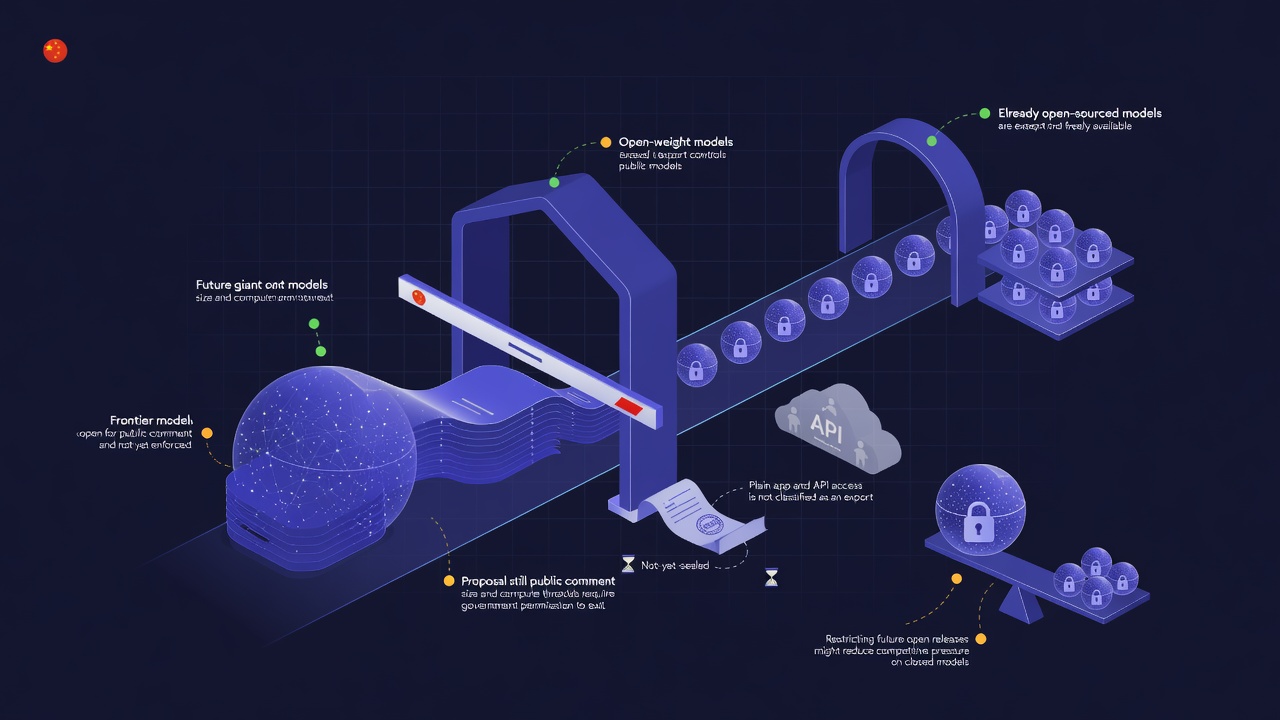
China's Ministry of Commerce published a draft that would pull a long list of AI technology into its export-control regime, 23 AI-related categories among 40 new entries, covering foundation models, agents and compute clusters. If you run Chinese open models like Qwen, DeepSeek, GLM or Kimi through an aggregator, the part that matters is the carve-out: anything already released as open source or published in a paper is exempt, and plain API or app access does not count as a technology export. The near-term hit to the open-weight supply is small. The longer-term signal is that Beijing now wants a say in whether the next giant model ships open at all.
What the draft actually says
The proposal is a revision to China's export-control catalog, jointly from the Ministry of Commerce and the science ministry. It adds 40 restricted or prohibited technologies, 23 of them AI-related, spanning large models, agent systems, compute clusters and related information-processing tech. The public comment window runs until November 15, 2026, and a temporary pre-export registration step applies in the meantime.
- Technology already in the public domain through open-source release or academic publication is exempt
- Giving people access to a model through an API, a SaaS product or an app is generally not treated as exporting the technology
- Future unreleased models may need registration or approval, keyed to thresholds the draft has not nailed down yet: capability, parameter count and data sensitivity
One widely shared reading from @zephyr_z9 put a number on the size trigger: Chinese labs would need permission to open-source a model above 2 trillion parameters or trained on more than 10^26 FLOPs. That is frontier scale, well above the models most people actually download and run today.
Why open weights mostly dodge it
The exemption for already-public technology is the whole story for current users. Qwen3, DeepSeek V4.1 Flash, GLM 5.3 and the rest are out, mirrored on Hugging Face and baked into countless local setups. A control that applies to future exports does not claw back weights that already shipped. Alibaba alone pulls roughly six times more open-weight downloads on Hugging Face than any other lab, and nothing in the draft reaches backward to touch those files.
Researcher @eliebakouch added three qualifiers worth keeping in mind. The rule is not in force yet, it is a draft out for comment. It covers closed models too, not just open ones. And the way it is written, open models may clear the permit step almost automatically, which would make the practical friction for future open releases lighter than the headline suggests.
Why it matters for anyone running multiple models
If you route work across several models, the cheap, strong Chinese open weights are a big part of why that works. They are the price anchor. DeepSeek V4.1 Flash costs a fraction of frontier US models per task, and Qwen's small models have, for a lot of everyday jobs, quietly replaced closed APIs. The worry on r/LocalLLaMA, where the news drew more than 1,400 comments, is the second-order effect: if Beijing slows future open releases while the US keeps its best models closed, the competitive pressure that forces anyone to publish weights eases off, and advanced models drift further behind paywalls.
That is the scenario to watch, not today's inventory. For now the move is the boring, sensible one: keep your options wide. An aggregator that lets you reach open and closed models from one place is worth more, not less, when any single supply line looks shaky. The value of being able to swap a model out goes up exactly when the politics around models gets loud.
The mirror image in Washington
None of this happens in a vacuum. The US has spent the past year tightening its own side, including pulling frontier models and chips out of reach for Chinese labs. We covered the week two Chinese open-weight models shipped as Anthropic's Fable 5 went dark under US export rules, and the pattern has only hardened since. China's draft is the other bookend: where Washington restricts what flows in, Beijing is sketching rules for what flows out. For open-model users caught in the middle, the lesson from both capitals is the same. Treat model access as something that can change on a policy memo, and build so that losing any one model is an inconvenience, not a crisis.
Video: China's AI export control proposal explained
A rundown of the draft catalog, the open-source exemption and how it fits the wider US-China AI standoff.
FAQ
Can I still use Qwen, DeepSeek and other Chinese open models?
Yes. The draft exempts technology that is already open-sourced or published, so the weights already on Hugging Face are not affected, and using a model through an API or app is not treated as an export. If you want an easy way to run several of them side by side, see our guide to running multiple AI models in one app.
What would actually be restricted?
Future, unreleased models above still-undefined thresholds for capability, parameter count and data sensitivity. One reading of the draft sets the open-source permit trigger around 2 trillion parameters or more than 10^26 training FLOPs, which is frontier scale, above the models most people download today.
Is this law yet?
No. It is a draft from China's commerce and science ministries, open for public comment until November 15, 2026, with a temporary registration step in place during the window. The thresholds and final scope could change before anything takes effect.
Should this change which models I rely on?
Not today, but it is a reason to avoid depending on any single model or provider. Chinese open weights are the main price anchor for affordable AI right now, and the safest response to policy risk on either side is to keep your open-model options and your closed ones both within reach.
Sources
- r/LocalLLaMA - China proposes export controls on 23 AI technologies, already open-sourced tech exempted
- @zephyr_z9 - permit needed to open-source models above 2T params or 10^26 FLOPs
- @eliebakouch - draft is not in force, covers closed models too, may license open models almost automatically
- Beijing News - draft revision to the export-control catalog and comment period
Further reading
Try all the models mentioned in this article
Admix gives you GPT-5, Claude, Gemini, and 350+ AI models in one app. Compare responses side by side. Try it for 7 days for $1.99.
Try Admix for $1.99