DeepMind's AI Agents Found Two Weaknesses in Legacy 1024-Bit RSA
Quick verdict
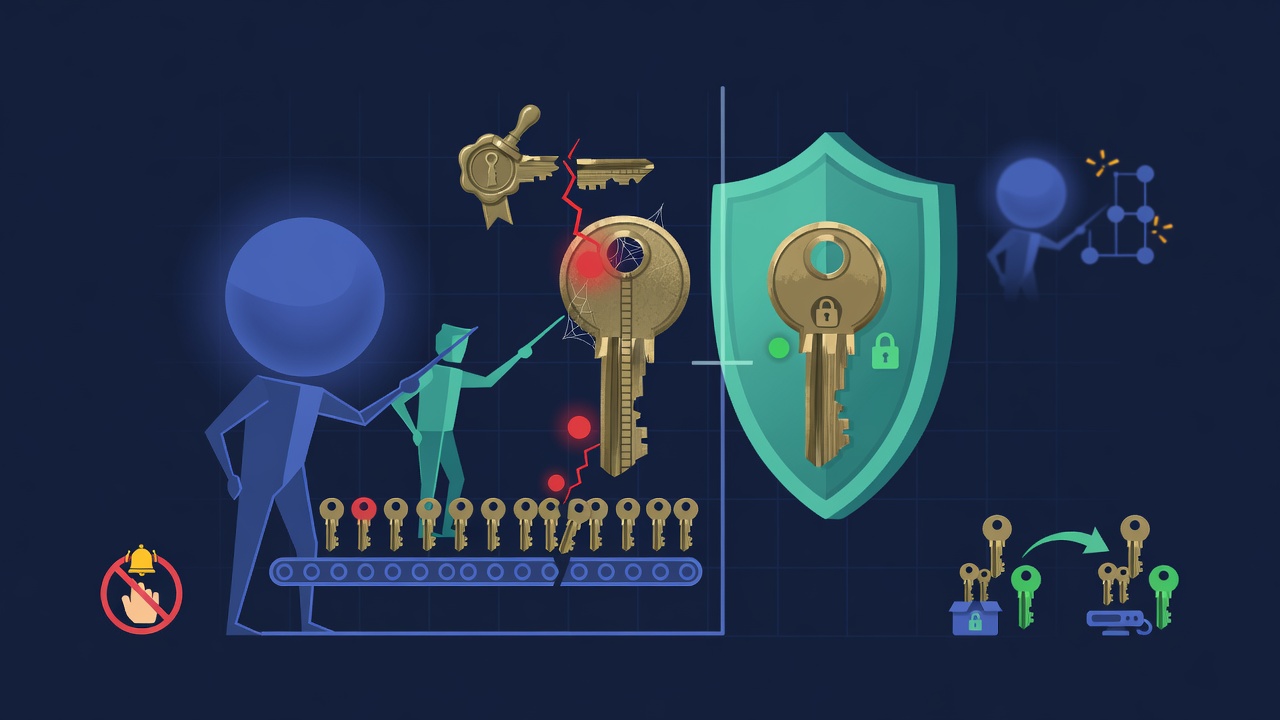
Google DeepMind says its AI agents, working with human experts, found two weaknesses in legacy 1024-bit RSA. One bypasses older signature protections, and the other enables bulk factoring of old 1024-bit keys. Before anyone panics: RSA-2048, the key size that actually protects the modern web, banks, and your messages, is not affected. The real news is not that encryption is broken. It is that an AI system did useful, verified cryptanalytic work next to human researchers, on a problem class that has resisted easy attacks for decades. That is a capability milestone worth paying attention to, and a hard nudge to finish retiring 1024-bit keys that should have been gone years ago.
What actually happened
Pushmeet Kohli, who runs science and strategic initiatives at DeepMind, and the official Google DeepMind account both posted that agentic AI, paired with human cryptographers, surfaced two distinct findings against 1024-bit RSA. The first weakness lets an attacker get around older signature protections. The second makes it possible to factor legacy 1024-bit keys in bulk, which is the step that turns a theoretical weakness into something an attacker could use at scale against systems still relying on that key size.
Two things keep this grounded. It was a human-plus-AI effort, not a model acting on its own, so the headline is AI as a research accelerator rather than an autonomous code-breaker. And the scope is legacy 1024-bit RSA specifically. RSA-2048 and larger, the sizes certificate authorities and browsers have required for years, are reported as unaffected. 1024-bit RSA has been formally deprecated for a long time. NIST pushed the industry off it over a decade ago, and public certificate authorities stopped issuing 1024-bit certificates back in 2014. So the practical blast radius is old infrastructure and long-lived keys that never got rotated, not the padlock in your browser today.
Why 1024-bit still matters even though it is "dead"
Deprecated does not mean gone. 1024-bit RSA keys still linger in places that are easy to forget and painful to change: embedded devices, old firmware signing keys, legacy PKI roots, internal services nobody has touched in years, and long-tail IoT hardware that will never get a firmware update. A technique that factors these keys in bulk matters most for anything with a long shelf life, where a key minted a decade ago is still trusted today. If a signing key can be forged, an attacker can sign malware that an old system treats as legitimate, which is exactly the kind of foothold supply-chain attacks are built on. We walk through that pattern in our look at AI and software supply-chain security.
There is also a "harvest now, decrypt later" angle. Encrypted traffic captured years ago, protected by a 1024-bit key, becomes readable the moment that key can be factored cheaply. For most organizations the fix is boring and known: inventory your keys, find anything still on 1024-bit, and rotate it to 2048-bit or move to elliptic-curve and post-quantum schemes. This finding is a reason to actually do it rather than leave it on the backlog.
The bigger pattern: AI is getting good at offense
This landed in the same week as another data point about AI and security. Vals ran a benchmark called CyberOffense, where AI agents tried to autonomously breach realistic enterprise networks. OpenAI's restricted GPT-6 Sol completed 80.8% of objectives, and the open-weight DeepSeek V4.1 Flash completed 72.8%. One detail stands out: the open model made most of its progress only after about 100 million tokens of work, so short test runs understate what these systems can do when you let them grind. Give an agent enough budget and it keeps going.
Put the two together and the direction is clear. AI is becoming a capable research partner for finding real weaknesses, in math-heavy cryptanalysis and in messy, multi-step network intrusion alike. That cuts both ways. The same capability that helps a lab find a flaw in legacy RSA helps defenders audit their own systems faster than before, the way AI has already been used to find real vulnerabilities in widely used software and to prove code correct with formal verification. The uncomfortable part is that attackers get the same tools. Whoever inventories and rotates their keys first wins; whoever waits is betting their old keys stay too expensive to factor, and that bet is getting worse every year.
Video: can AI actually break encryption?
A rundown of the DeepMind finding and what it does and does not mean for everyday encryption.
FAQ
Is my data at risk because of this?
Almost certainly not. The findings apply to legacy 1024-bit RSA. The modern web, banking, and messaging apps use RSA-2048 or elliptic-curve keys, which DeepMind reports as unaffected. The risk is concentrated in old systems still running 1024-bit keys.
Did an AI break RSA on its own?
No. This was AI agents working with human cryptographers, and only against the old 1024-bit key size. It is a human-plus-AI research result, not a model autonomously defeating encryption.
What should I actually do?
If you run infrastructure, inventory your keys and certificates, find anything still on 1024-bit RSA, and rotate to 2048-bit, elliptic-curve, or post-quantum options. Pay special attention to firmware signing keys and long-lived PKI roots.
Is this related to quantum computing?
No. This is classical cryptanalysis sped up by AI, not a quantum attack. Quantum threats to RSA are a separate, longer-horizon problem, though the practical advice, move off weak legacy keys, overlaps.
Sources
- @pushmeet - DeepMind AI agents plus human experts found two weaknesses in legacy 1024-bit RSA
- @GoogleDeepMind - signature bypass and bulk factoring of legacy keys, RSA-2048 unaffected
- @ValsAI - CyberOffense benchmark, AI agents autonomously breaching enterprise networks
Further reading
Try all the models mentioned in this article
Admix gives you GPT-5, Claude, Gemini, and 300+ AI models in one app. Compare responses side by side. Try it for 7 days for $1.99.
Try Admix for $1.99