Claude Wrote 180 Million Lines of Proof to Lock Down 123 Open-Source Libraries
Quick verdict
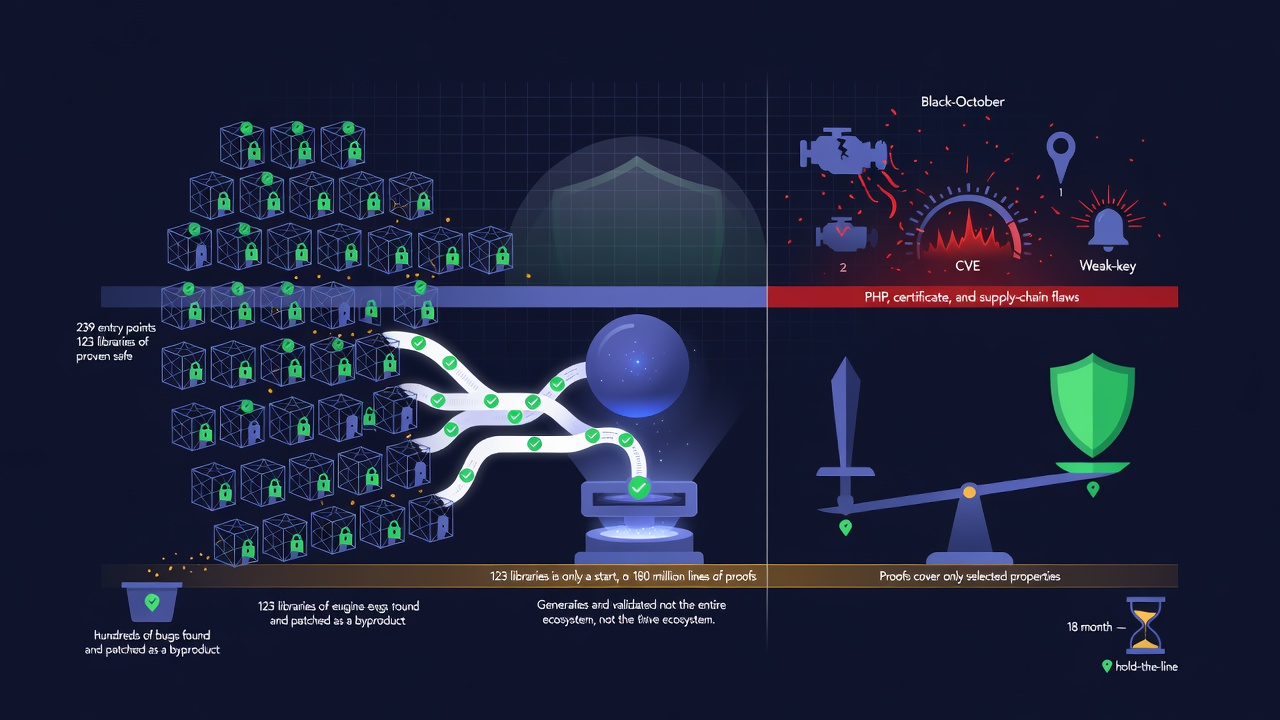
For a few days the timeline was one long panic: AI was finding critical bugs faster than anyone could patch them, a wave people started calling Black October. The part that got far less attention is that the same capability was running in the other direction. Anthropic's Frontier Red Team, working with Theorem Labs, used Claude to prove security properties across 123 open-source libraries in a matter of weeks, generating roughly 180 million lines of machine-checked proofs and patching hundreds of bugs along the way. If you only read the scary half of the week, you got half the story. Formal verification at this scale is the strongest guarantee software can have, and it just became something a model can produce in bulk.
What actually shipped
This was not another "AI found a bug" demo. Formal verification is a different and much harder thing than testing. A test checks that the code did the right thing on the inputs you tried. A proof checks that the code does the right thing on every possible input, and a machine checks the proof so you are not trusting anyone's judgment about whether it holds. That is why serious verification work has always been slow and expensive, reserved for aircraft control systems and cryptography, not ordinary libraries.
The reported figures are what make this notable:
- About 180 million lines of machine-checked proofs, produced in weeks rather than years
- Coverage of 239 entry points across 123 libraries
- Hundreds of bugs found and patched as a byproduct of writing the proofs
The bug count matters, but the proof count matters more. Once a property is proven and machine-checked, that whole class of failure is closed, not just the one case a fuzzer happened to hit. Anthropic framed this as a demonstration that Claude can carry the grunt work of verification, which is the part that normally stops teams from attempting it at all.
The week this landed in
The proof work did not land in a vacuum. It shipped in the middle of a brutal disclosure wave. PHP2Shell, a GitLab flaw rated CVSS 10 reaching back to 2014, a Node.js decoder bug, a poisoned LiteLLM release with a password stealer, and a certificate authority whose keys were reportedly weak enough that one of them was the number 4. Monthly CVE volume has reportedly climbed from about 4,000 to about 15,000 since April. We covered the offensive side of this in detail in our piece on the PHP bugs that AI models helped discover.
So the natural reaction was that offense is winning. Several researchers pushed back on that read. Stella Biderman argued the "offense winning" framing was essentially disinformation, pointing out that much of the week was defensive audit work surfacing, not attackers running wild, and that there was no evidence of large-scale exploitation. Joshua Achiam reportedly noted that only about 4 of roughly 16 major incidents actually happened that week. The rest were found earlier and disclosed together. The verification project is the clearest example of the defensive side the panic skipped over.
Why it matters
The thing worth holding onto is that AI security capability is not inherently an offense story. It is a speed story, and speed helps whoever points it at a problem first. The same model that can find a memory-corruption bug can also write the proof that rules that bug out forever. Which side moves faster is now partly a question of who decides to spend the compute.
That reframes the defender's job. It used to be true that an attacker needed to find one hole while a defender had to close all of them, an asymmetry that always favored offense. Verification at scale chips at that. If you can prove a library's entry points are safe rather than testing them, you are closing holes by the class instead of one at a time. Anthropic's own Deputy CISO Jason Clinton was blunt that things get worse before they get better, and that defenders need to hold on for roughly 18 months. Tools like this are what "holding on" looks like in practice.
There is also a competitive angle worth watching. The labs are increasingly measured on this kind of hard, verifiable work rather than chat-quality vibes, which is the same trend we traced in our look at how Anthropic now evaluates Claude on cyber tasks. Coding and security are converging into one benchmark, and the models that can do the boring, rigorous parts are the ones that will matter in a security budget.
Video: formal verification, explained
If the phrase "machine-checked proof" is new to you, this walkthrough covers why formal verification is a stronger guarantee than testing and why AI assistance changes its economics.
FAQ
Is formal verification the same as AI finding bugs?
No, and the difference is the whole point. Bug-finding shows a flaw exists. Formal verification proves a property holds for every input, and a machine checks that proof. The verification project found hundreds of bugs as a side effect, but the lasting output is the proofs that close whole classes of failure.
Does this mean open-source software is now safe?
No. 123 libraries is a start, not the ecosystem. Verification also only proves the specific properties you chose to prove, so a verified library can still have gaps outside that scope. It lowers risk sharply in the code it touches rather than declaring anything bulletproof.
Which model did the work?
Anthropic credited Claude, run by its Frontier Red Team with Theorem Labs. If you want the capability picture behind that, our rundown of the latest Opus release covers what these models can now do on long, rigorous tasks, and our guide to the best AI coding agents covers how that translates to day-to-day work.
Sources
- Anthropic - formal verification across 100+ open-source libraries with Claude
- Summary of the figures: ~180M lines of proofs, 239 entry points, 123 libraries
- Stella Biderman - the "offense winning" framing is misleading
- Jason Clinton (Anthropic Deputy CISO) - worse before better, hold on ~18 months
- On disclosure timing: ~4 of ~16 incidents actually happened that week
Further reading
Try all the models mentioned in this article
Admix gives you GPT-5, Claude, Gemini, and 350+ AI models in one app. Compare responses side by side. Try it for 7 days for $1.99.
Try Admix for $1.99