Ornith-1.5 Ships as an MIT-Licensed Open Model That Scores 86 on SWE-Bench Verified
Quick verdict
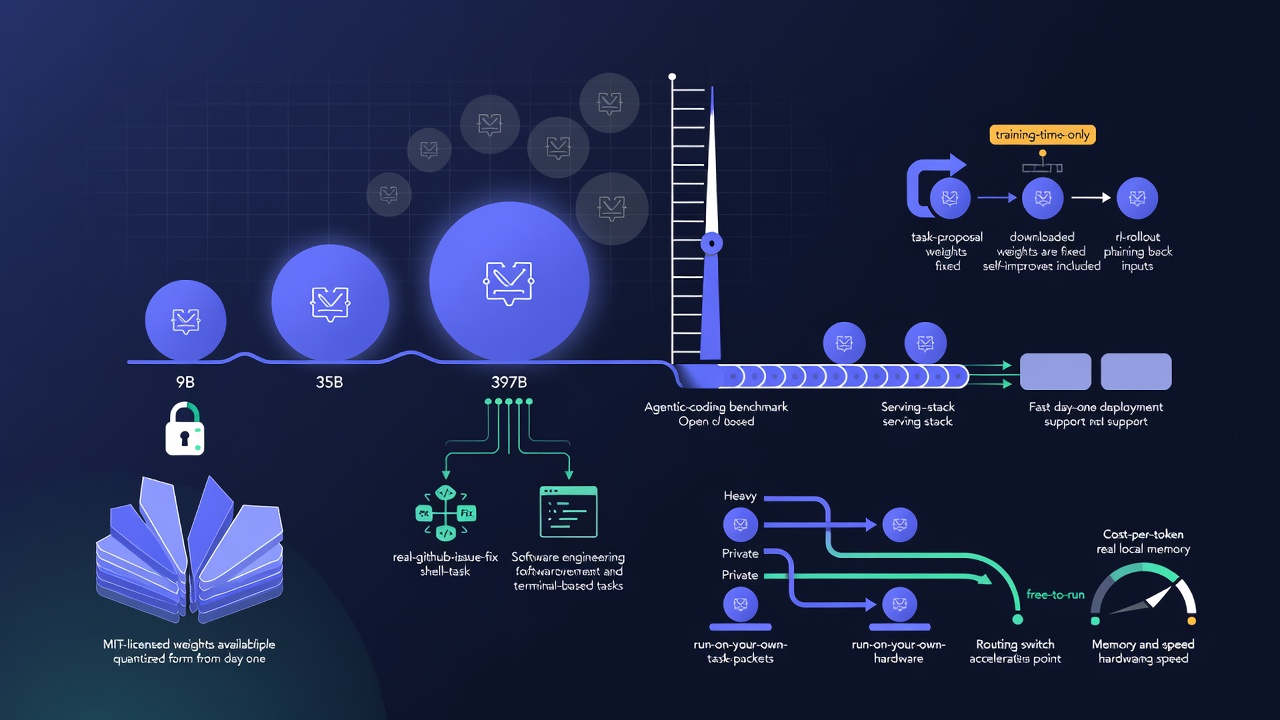
Ornith-1.5 is a new open-weight model family released under an MIT license, which means you can run it, fine-tune it, and ship it in a product without asking anyone. It comes in three sizes: a 9B dense model, a 35B mixture-of-experts, and a 397B mixture-of-experts. The headline is the coding and agent numbers. On SWE-Bench Verified it reports 86, and on Terminal-Bench 2.1 it reports 86.1, which puts it in the same conversation as the paid frontier rather than a step behind it. The self-improvement pitch attached to the launch is the part to hold at arm's length. The weights and the benchmark deltas are what matter today, and both are real enough to change how you think about paying for a coding agent.
What actually shipped
Three model sizes went out at once, all under MIT, all with quantized formats ready on day one: FP8, GGUF, MLX, and NVFP4. That last detail is the practical one. You do not have to wait for the community to convert anything before you can run the 9B on a laptop or the 35B on a single workstation GPU. Serving support landed fast too, with vLLM and Ollama both wiring the models into their stacks within a day of the release.
The reported evals are strongest on agentic and coding work, which is where an open model competing with a subscription actually saves you money.
| Benchmark | Ornith-1.5 (397B MoE) | What it measures |
|---|---|---|
| SWE-Bench Verified | 86 | Fixing real GitHub issues |
| Terminal-Bench 2.1 | 86.1 | Multi-step work in a shell |
| Tool Decathlon | 71.2 | Tool use across varied tasks |
| DeepSWE | 56 | Harder software engineering |
| HLE | 44.6 | Broad expert-level reasoning |
Read those the way you would read any vendor-reported card: as a claim to verify, not a settled result. SWE-Bench Verified in the mid-80s is genuinely strong, and the fact that the whole family is open means independent testers can check it directly instead of trusting a screenshot. That is the difference between an open release and a closed one. The benchmark either holds up when other people run it or it does not, and you will know within a week.
The self-improvement claim, minus the hype
The release leans hard on a self-improvement story: the model proposes its own tasks, generates scaffolds, and produces reinforcement-learning rollouts to create new training experiences. Stripped of the framing, that describes a training pipeline that generates and filters its own data, which several labs already do in some form. It is a reasonable way to squeeze more out of a base model. It is not evidence of a model that keeps getting smarter on your machine after you download it. The weights you pull are fixed. Treat the self-improvement line as a description of how Ornith was trained, not a feature you get at inference time.
Why it matters if you pay for a coding agent
Here is the part that lands on your bill. A coding subscription is worth paying for when the hosted model is clearly better than anything you can run yourself. Every time an open model closes that gap, the case for the subscription gets weaker, at least for the work the open model can handle. Ornith-1.5 at 86 on SWE-Bench Verified is close enough to the paid frontier that a lot of routine fixes, refactors, and test-writing no longer need a metered API call. You run the 35B locally, keep the code on your own disk, and pay nothing per token.
The catch is the one open-model users always hit, and it is not quality. It is speed and hardware. A 397B model needs serious memory, and even the 35B wants a real GPU to feel responsive. The people cheering these releases the loudest are the ones who already own the hardware. If you do not, a hosted model is still faster and cheaper than buying a rig. The honest framing is a split: heavy or private work moves to a local open model, and the rest stays on whatever hosted model is fastest for the money. That is a routing decision, not a loyalty decision, which is exactly the case for not locking yourself into a single provider.
Video: are local coding agents good enough yet
For a grounded look at where local coding agents actually stand against hosted ones, and where they still fall down, this walkthrough is a good reality check:
FAQ
What can I actually do with an MIT license here?
Run it, modify it, fine-tune it, and use it commercially with no usage caps and no permission needed. MIT is about as permissive as licenses get, so the only real limits are your hardware and your willingness to verify the benchmark claims yourself.
Which Ornith size should I run?
The 9B dense model fits on a laptop and is fine for light autocomplete and small edits. The 35B MoE is the sweet spot for a local coding agent if you have a capable GPU. The 397B is for people with server-class memory or a hosting provider, and it is the one carrying the top benchmark numbers.
Does this replace my coding subscription?
For some of your work, maybe. For all of it, probably not yet, mostly because of speed and hardware rather than quality. The realistic move is to route heavy or private tasks to a local model and keep a hosted option for everything else. See our rundown of the best AI coding agents for how the hosted options compare.
Sources
- @ornith_ - Ornith-1.5 release: 9B to 397B, MIT license, and the coding benchmark claims
- @vllm_project - day-one serving support for Ornith-1.5
- @ornith_ - Ornith-1.5 available in Ollama
Further reading
Try all the models mentioned in this article
Admix gives you GPT-5, Claude, Gemini, and 350+ AI models in one app. Compare responses side by side. Free to start.
Start free on Admix