Mistral Large 4 'Le Chonk' Is the Best Open Model Built Outside China, and It Costs Half the Preview
Quick verdict
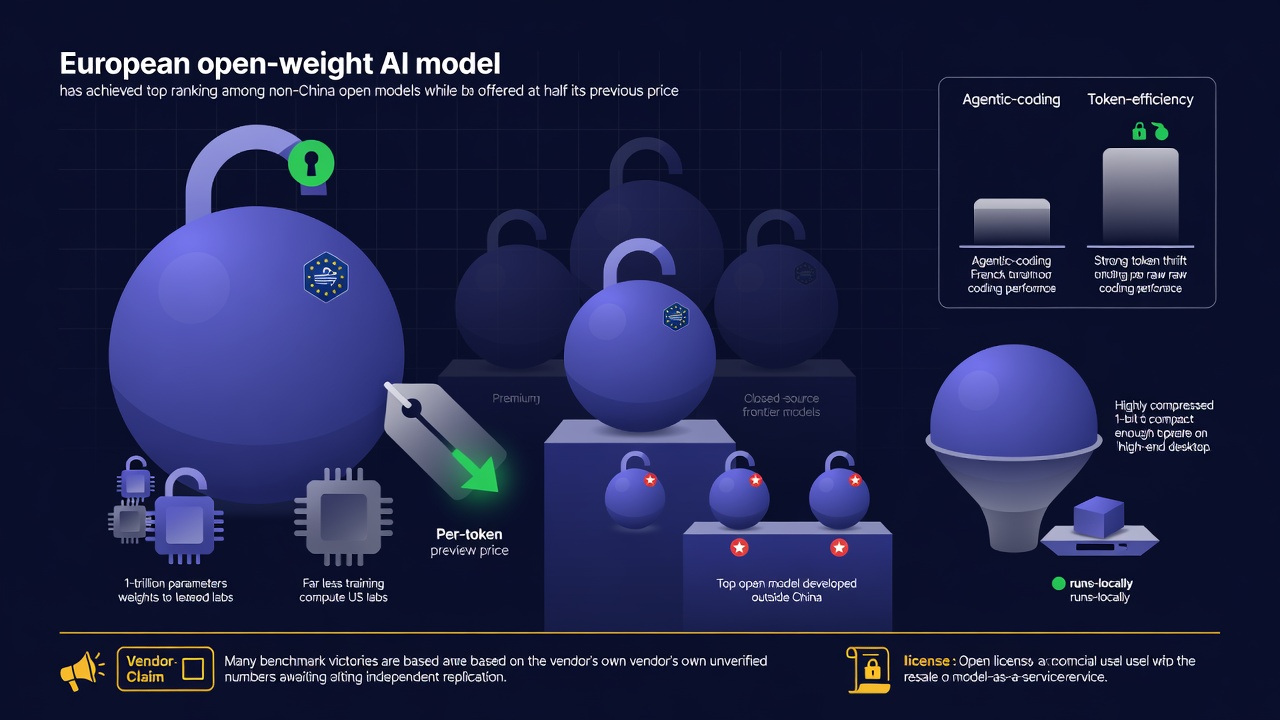
Mistral shipped open weights for Mistral Large 4, nicknamed "Le Chonk," a 1.05T-parameter model with 52B active, 1M context, and text plus image input. The headline for anyone paying a bill is the price: $0.70 per million input tokens and $2.10 per million output, with cached input at $0.07, roughly half what the Preview cost. Artificial Analysis scores it 26 on its Intelligence Index v5, which makes it the top open model developed outside China, one point above Meta's Muse Spark Open. It still trails the Chinese open leaders, DeepSeek V4.1 Flash and GLM 5.3, by six points. If you have wanted a capable Western open-weight model you can download and run, this is the strongest one yet, with the usual caveat that most of the splashy benchmark claims are Mistral's own until someone reproduces them.
What actually shipped
One flagship, released open-weight with same-day ecosystem support. The specs, per Mistral's blog and Artificial Analysis:
- 1.05T total parameters, 52B active, built as a mixture of experts with 128 routed experts plus one shared, four routed experts active per token. Context is 1M tokens with a 256K maximum output.
- Pricing is $0.70 per million input and $2.10 per million output, $0.07 on cached input. That is about 50% below the Preview, which is the real story for high-volume use.
- It was trained from scratch on roughly 3,800 NVIDIA Grace Blackwell GPUs on European infrastructure, which is a fraction of what the largest US labs train on.
- The license is Mistral's Ecosystem Open-Weight License. You can download and run it, but a model-as-a-service business needs a separate commercial license.
On the numbers, Artificial Analysis put it at 26 on Intelligence Index v5, top among open models outside China and one point ahead of Muse Spark Open, six behind DeepSeek V4.1 Flash and GLM 5.3. Coding is more of a mixed bag: it scored 15% on FrontierCode 2.0 against 29% for DeepSeek V4.1 Flash and 22% for GLM 5.3, but reached 25% on Terminal-Bench 4.0 versus 8% for Muse Spark Open. On the Coding Agent Index it landed at 48 using 8.5M tokens per task, close to GLM 5.3's 49 while using nearly half the tokens. Hallucination fell from the Preview's 41% to 28% on AA-Omniscience, though factual accuracy stayed low at 26%. Mistral's own claim of a 64% human-preference win rate against GLM 5.3 and Kimi K3 is the kind of number worth testing yourself before trusting.
The ecosystem moved the same day, which is usually the signal that matters. vLLM shipped support for the FP8 and NVFP4 checkpoints with a built-in DSpark drafter for 1.92 to 2.23x output throughput. Unsloth's 1-bit GGUF squeezes the model to 223GB, down from 1.1TB in FP8, keeps 91% of top-1 accuracy, and runs on a Mac Studio. TRL added single-node LoRA fine-tuning on eight B300s. The architecture is its own talking point: a community breakdown describes full sparse attention in the style of DeepSeek V3.2 and GLM 5, a shared KV cache across NoPE layers after layer 35, SSMax per-head logit scaling, and a LeRoPE variant, with no KV compression.
Why it matters
For a year the strongest open-weight models have come almost entirely from Chinese labs. Mistral Large 4 is the first Western release to get back into that conversation, and it did it at a price that undercuts its own Preview by half. That is the pattern worth watching: open weights keep closing the gap on the paid frontier faster than paid subscriptions get cheaper. We track where that leaves the open field in open-source AI models in 2026 and why the Chinese labs have been setting the pace in Chinese open models climbing OpenRouter.
The cheap API tier is the part most people will actually use. At $0.70 in and $2.10 out, Large 4 sits well under the frontier closed models for a lot of everyday work, and it is strong at agentic coding while spending fewer tokens per task than GLM 5.3. The practical move is rarely "run one model for everything." It is routing cheaper models to the tasks that fit them and saving the expensive frontier for the hard ones, which is the case we make in cutting AI coding agent costs with model routing. If you would rather not lock into one provider's API, running Large 4 next to Claude, GPT, and Gemini behind one subscription is covered in the best app for running multiple AI models.
The local-download angle is real but narrower than the open-weight label suggests. A 1.05T model, even at 52B active, is not something most people run at home. Unsloth's 223GB 1-bit build on a Mac Studio is impressive, but it is still a high-end-workstation story, not a laptop one. For most readers the value is the hosted version on an aggregator, not a weekend of local setup. Where it fits in the current coding lineup is the better question, and that is what the best AI coding agents guide is for.
Video: Mistral Large 4 reviewed
A walkthrough of the Large 4 launch, the open-weight release, and whether the benchmark claims hold up against the Chinese open leaders.
FAQ
Are the Mistral Large 4 weights actually open?
Yes, they are on Hugging Face under Mistral's Ecosystem Open-Weight License, so you can download and run them. The catch is the license: a model-as-a-service business needs a separate commercial license, so it is open for most uses but not a blanket Apache-style grant.
How does it compare to DeepSeek V4.1 Flash and GLM 5.3?
Artificial Analysis puts Large 4 six points behind both on its Intelligence Index v5, and DeepSeek V4.1 Flash nearly doubles it on FrontierCode 2.0. Large 4's edge is token efficiency on agent tasks and being the strongest option built outside China. For the Chinese side of that race, see our writeup of DeepSeek V4.1 Flash.
Can I run it locally?
Technically yes, practically only on serious hardware. Unsloth's 1-bit GGUF is 223GB and runs on a Mac Studio while keeping 91% of top-1 accuracy, but that is a workstation, not a typical laptop. For most people the hosted API or an aggregator is the realistic path.
Is it cheaper than the big closed models?
For input and output tokens, yes, by a wide margin at $0.70 and $2.10 per million. Whether it is cheaper per finished task depends on how many tokens your work burns, which is why routing matters more than any single sticker price. We go through that math in the best AI aggregator.
Sources
- @MistralAI - Mistral Large 4 open-weight announcement
- Mistral - Mistral Large 4 release post
- Hugging Face - mistralai/Mistral-Large-4-1T-A52B weights
- Artificial Analysis - independent evals, specs and pricing
- @b_roziere - 64% human-preference win-rate claim
- @eliebakouch - architecture breakdown
- vLLM - day-0 FP8/NVFP4 serving support
- @UnslothAI - 1-bit GGUF running on a Mac Studio
Further Reading
Try all the models mentioned in this article
Admix gives you GPT-5, Claude, Gemini, and 300+ AI models in one app. Compare responses side by side. Try it for 7 days for $1.99.
Try Admix for $1.99