Meta's Muse Code Puts It in the Coding-Agent Race With Claude Code and Codex
Quick verdict
Meta shipped two things at once: Muse Spark 1.2, an update to its cheap coding model, and Muse Code beta, its first serious terminal agent harness. The interesting part is not the model version bump. It is that Meta co-trained the model and the harness together, and the benchmarks that came out of it put Meta in the same conversation as Claude Code and Codex for the first time. If you run coding agents, this is a new lane worth watching, especially on price.
What actually shipped
Two pieces, designed to work as one:
- Muse Spark 1.2 lands at 54 on Artificial Analysis's Intelligence Index, effectively tied with some leading US models just below the very top tier. Pricing held at $1.25 per million input tokens and $4.25 per million output tokens, with discounted cache hits.
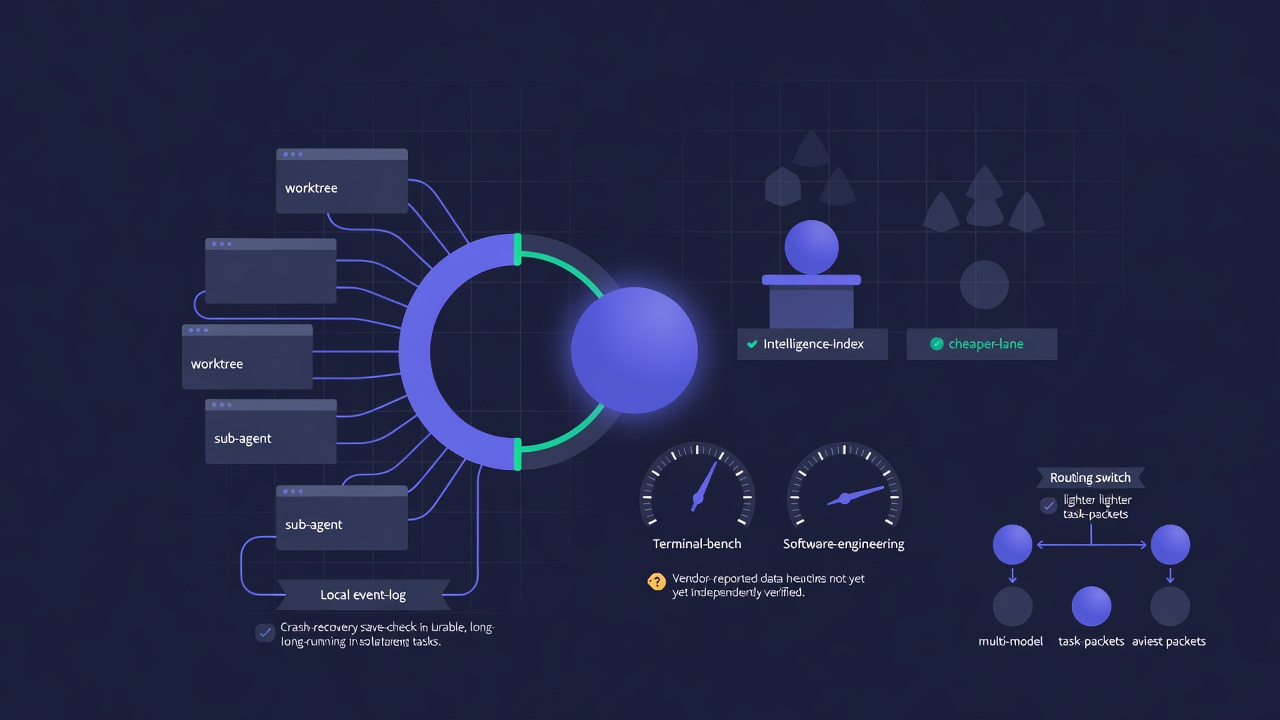
- Muse Code beta is the harness. It runs persistent specialized agents, spawns parallel sub-agents in isolated worktrees, and keeps a local event log so long tasks survive crashes.
- The benchmarks are the reason people paid attention: 82.9% on Terminal-Bench 2.1 and 59.3% on DeepSWE 1.1. Those numbers put a coding agent in serious company, not a toy.
- Co-design is the pitch. Meta trained the model and harness together to get better first-attempt tool use and less reprompting.
The architecture reads like a direct answer to what already works. Persistent context, fan-out sub-agents, validation loops, multimodal inputs, and long session durability are the same building blocks behind Claude Code, Codex, and Devin-style systems. Meta did not reinvent the pattern. It matched it and priced it aggressively.
Why it matters
The takeaway that experienced practitioners latched onto is harness-model co-design. For a while the story was raw model quality: whoever had the smartest weights won. That is no longer the whole picture. On the same backbone, a better harness can move real-task accuracy by double digits, which means the agent wrapping the model now carries as much weight as the model itself.
Meta training both together, rather than shipping a model and hoping someone builds a good harness around it, is the point. It signals that the coding-agent race is now about the pairing, and it gives teams another vendor to route work to when Claude Code or Codex is overkill or overpriced for the task. At $1.25/$4.25, Muse Spark 1.2 is priced to win the "good enough, cheap, fast" tier that handles most day-to-day coding work.
Where it lands vs the field
| Metric | Muse Spark 1.2 + Muse Code |
|---|---|
| Artificial Analysis Intelligence Index | 54 (near-top tier) |
| Terminal-Bench 2.1 | 82.9% |
| DeepSWE 1.1 | 59.3% |
| Pricing (input / output per 1M) | $1.25 / $4.25, cache discounts |
| Harness design | Persistent agents, parallel worktrees, local event log |
The honest read: Muse Code is not the smartest agent on the board, and one launch does not dethrone the incumbents. But it is close enough on benchmarks and cheap enough on price that it belongs in a routing setup, not a footnote.
Video: Meta's coding-agent push
For a look at Muse Code and how the harness fits Meta's coding strategy, watch this.
FAQ
What is Muse Code?
Meta's terminal-based coding agent harness, released in beta alongside Muse Spark 1.2. It runs persistent specialized agents, spawns parallel sub-agents in isolated worktrees, and keeps a local event log so long tasks survive crashes.
How does it compare to Claude Code and Codex?
On benchmarks it is close: 82.9% on Terminal-Bench 2.1 and 59.3% on DeepSWE 1.1, with an Artificial Analysis Intelligence Index of 54. It is not the outright leader, but at $1.25/$4.25 per million tokens it is a strong cost-performance option to route work to.
What does harness-model co-design mean?
Meta trained the model and the agent harness together instead of separately. The goal is better first-attempt tool use and less reprompting, because the model learns the harness it will actually run inside.
Sources
- @AIatMeta - announcing Muse Spark 1.2 and Muse Code beta
- @finkd - on Meta's move into coding agents
- @alexandr_wang - on the Muse Code launch
- @ArtificialAnlys - benchmark scores and pricing for Muse Spark 1.2
Further reading
Try all the models mentioned in this article
Admix gives you GPT-5, Claude, Gemini, and 350+ AI models in one app. Compare responses side by side. Free to start.
Start free on Admix