K2 Horizon Ships Six Open Models and, Unusually, the Whole Recipe
Quick verdict
A lab called IFM dropped K2 Horizon, a fleet of six open models running from a tiny 0.9B up to a sparse 375B mixture-of-experts. The benchmark claims are loud, and you should treat them with the usual caution. The part worth your attention is quieter: IFM is releasing the training data, the data-construction recipe, the training code, the configs, the logs, the intermediate checkpoints, and the final weights, most of it under Apache 2.0. Almost nobody at this size does that. For anyone who wants open models they can actually trust and self-host, that is the news.
What actually shipped
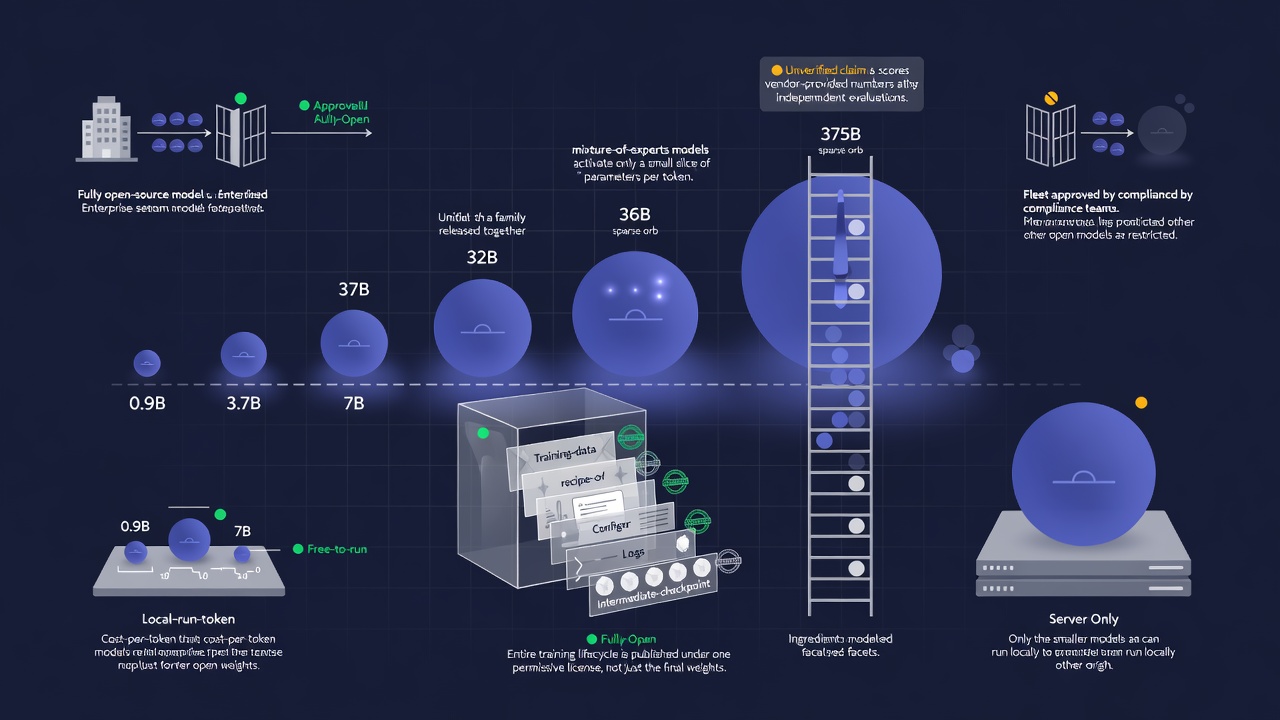
K2 Horizon is not one model, it is a lineup. The sizes are 0.9B, 3.7B, 7B, 32B, a 36B sparse model with 4B active parameters per token, and a 375B sparse model with 23B active. GGUF builds for local inference went up on Hugging Face on day one, so the small and mid sizes are runnable on a normal machine right now, not "coming soon."
The headline architecture piece is the 36B-A4B model, which uses something IFM calls MoVA, or mixture-of-value attention. The claim is that it reaches roughly dense 32B-class quality while only lighting up about 4B parameters per token. It also ships a native context window of 524,288 tokens. On the training side, IFM cites around 20 trillion pretraining tokens, roughly 10 trillion of them synthetic, and about 17% explicit reasoning trajectories in the mix.
The benchmark story is the one to hold loosely. IFM says the fleet lands at or near frontier level on math, reasoning, coding, tool use, and agentic tasks, with the small 0.9B, 3.7B, and 7B models punching above their weight class. Reddit's local-model crowd was split in the predictable way. Some were impressed, several asked the fair question of whether the numbers are real capability or benchmark overfitting, and a few pointed out that IFM is not yet a name anyone recognizes. Take the leaderboard as a marketing claim until independent evals land.
Why the openness is the real story
Most "open" model releases are open-weight and nothing more. You get a file of numbers and a license, and the data and the training process stay locked up. K2 Horizon is going the other way. IFM says it will publish the intermediate checkpoints, the training data or the recipe used to build it, the architecture details, the mixture compositions, the training code and configs, the logs, the eval results, the post-training branches, and the weights, and it is doing this for the whole lineup including the 375B model. Commenters traced the lab back to the LLM360 and MBZUAI open-research world, which fits the pattern of a group whose product is reproducibility, not a hosted API.
That level of disclosure changes what you can do with the model. You can audit what it was trained on. You can fine-tune from a real base instead of guessing. You can reproduce a checkpoint if you have the compute. For a company deciding whether to build on open weights, "we can see the whole pipeline" is worth more than two points on a benchmark nobody can independently verify yet.
The compliance angle nobody says out loud
The open-weight leaderboards have been dominated by Chinese labs. Qwen, DeepSeek, GLM, and Kimi are genuinely strong, and plenty of teams run them. But a real slice of enterprise and government buyers cannot or will not deploy a Chinese-origin model, for policy or procurement reasons rather than quality ones. One Reddit commenter said it plainly: open weights from a different origin are useful precisely for organizations that are blocked from using Qwen.
That is the lane K2 Horizon is aiming at. A fully open, Apache 2.0, Western-research-lineage fleet that a compliance team can actually sign off on. If the quality holds up under independent testing, that is a distinct market from "cheapest open model on OpenRouter," and it is one the Chinese labs cannot serve. It slots next to the broader shift we covered when AT&T moved 40% of its AI to open models: the demand for open weights is real, and buyers care about where they come from.
Video: what open-weight models are and how to run them
A plain-language primer on open-weight models and what it means to run one locally, useful context if K2 Horizon's GGUF builds are your first time self-hosting.
What it means for you
If you self-host, the small K2 Horizon sizes are the interesting ones. A 3.7B or 7B model that holds up on reasoning and tool use is the kind of thing that runs on a laptop and handles the boring 80% of requests for free, which is the same routing logic that saves money at enterprise scale. Our roundup of the open-source models worth running in 2026 is the place to compare, and if coding is your use case, the best models for coding covers where open weights actually keep up.
If you do not self-host, the takeaway is simpler. More credible open competition pushes prices down and keeps the frontier labs honest, and you do not have to run K2 Horizon yourself to benefit from that. The way to capture it without juggling a dozen providers is a single account that reaches all of them, which is the case for an AI aggregator over a stack of subscriptions.
FAQ
Is K2 Horizon actually better than Qwen or DeepSeek?
Unproven. IFM's own benchmarks say it is competitive, but those are vendor numbers on a brand-new lab, and independent evals have not landed. What is verifiable today is the openness of the release, not the ranking. Treat the leaderboard as a claim until third parties confirm it.
Can I run it on my own machine?
The smaller sizes, yes. GGUF builds for the 0.9B, 3.7B, 7B, 32B, and 36B-A4B models are on Hugging Face, so anything up to the mid sizes runs locally with llama.cpp-style tooling. The 375B model is a server-class deploy, not a laptop job.
What does "fully open source" mean here versus open weight?
Open weight means you get the model file and a license. Fully open source, as IFM is using it, means you also get the training data or recipe, the code, the configs, the logs, and the intermediate checkpoints, so the whole thing is auditable and reproducible. That is the rare part.
Sources
- r/LocalLLaMA - Introducing K2 Horizon: Frontier Performance, Radically Open
- r/LocalLLaMA - IFM/K2-Horizon-MoVA-36B-A4B-GGUF on Hugging Face
- Hugging Face - the K2 Horizon model collection
- Hugging Face - K2-Horizon-MoVA-36B-A4B GGUF build
Further reading
Try all the models mentioned in this article
Admix gives you GPT-5, Claude, Gemini, and 350+ AI models in one app. Compare responses side by side. Try it for 7 days for $1.99.
Try Admix for $1.99