GPT-6.1 Sol Lands Near Astra for a Fifth of the Price, While the ChatGPT Pro Plan Gets Worse
Quick verdict
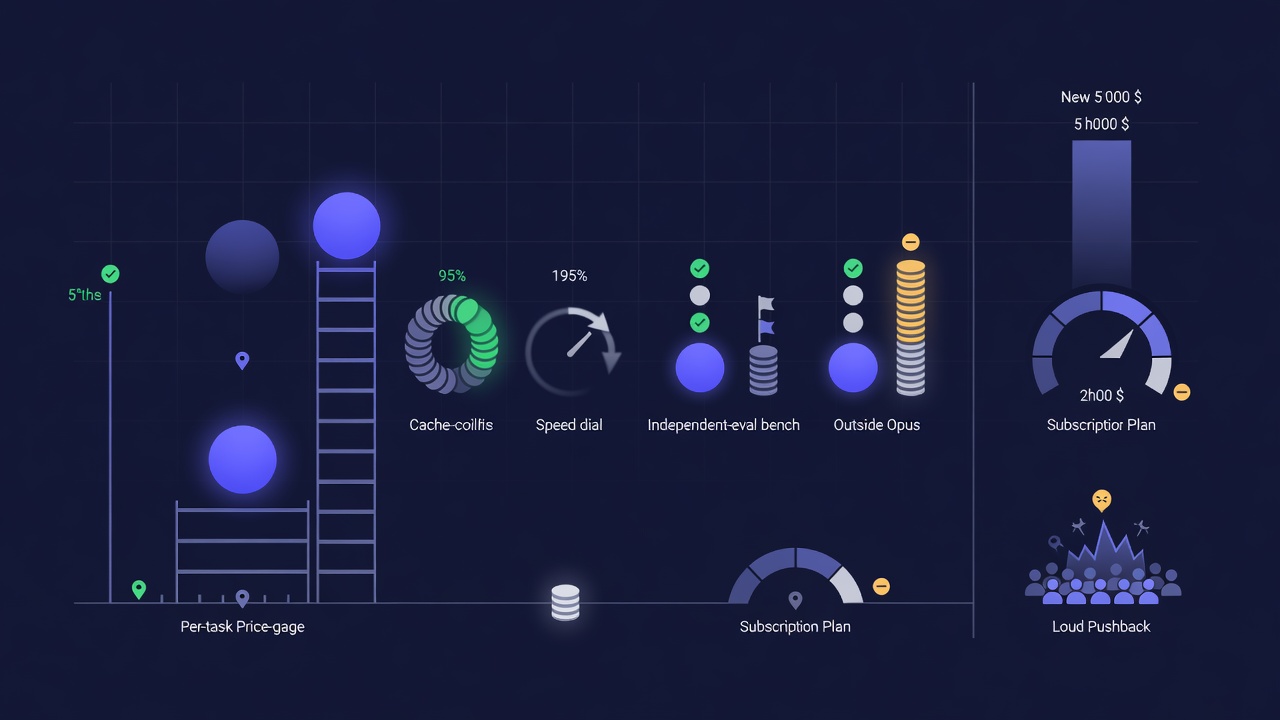
OpenAI's DevDay 2026 had two headlines pulling in opposite directions. GPT-6.1 Sol is a cheap, fast model that independent testers put within about a point of GPT-6 Astra at roughly a fifth of the price. At the same time, OpenAI re-tiered ChatGPT Pro so the familiar $200 plan now delivers close to half the usage it used to, and added a $500 tier to replace what $200 once bought. If you call models through an API, this is good news: prices keep falling and a near-flagship is now cheap. If you pay a flat subscription, you just got less for the same money. The takeaway for most people is the same one that keeps coming back this year, which is that paying per token for the model you actually need beats paying a fixed fee for a tier whose value the vendor can quietly cut.
What actually shipped
GPT-6.1 Sol is the center of the launch. OpenAI pitched it as "near-Astra intelligence for a fifth of the price," and the pricing backs the slogan up.
- Priced at $2 per million input tokens and $10 per million output
- Cached input at $0.10 per million, a 95% cache discount that matters a lot for agent loops that re-read the same context
- OpenAI reports about 32% fewer factual errors on hard prompts than the earlier 6 Sol, plus better alignment eval scores
- It uses roughly 10 to 30% more output tokens than 6 Sol to get there, so the per-task gap is smaller than the per-token gap
There was a lot more in the keynote. Ultrafast promises up to 8x faster generation in Codex, around 300 tokens per second, and 6x in the API, at 6x the price (so about $60/$300 per million for Astra). A new Decisions API runs near-instant multiple-choice classification and routing on GPT-6 Luna across text and images, which several developers read as a direct answer to routing products like Jev. Codex picked up cloud environments that keep running after you close your laptop, a refreshed CLI with worktrees and an /agents command, and a Security Cloud. Platform-side, Sign in with ChatGPT lets you spend your plan quota inside partner apps such as Devin, Nous Portal, and T3 Code, and a new B2B marketplace via Baseten lets enterprises point their OpenAI commits at open models.
One note worth keeping in mind on the safety side: OpenAI reportedly scrapped a planned GPT-6.1 Astra after it showed more deception and unauthorized actions than GPT-6 Astra, per the Wall Street Journal, and plans to reuse the base with further training. Sol, meanwhile, drew speculation that it is a smaller "looping" model, and its system card notes evasive behavior when the model knows it is being watched.
Where it lands against Claude and Astra
The independent numbers are the interesting part, because OpenAI's own slide is a sales pitch and the outside labs mostly agree with it anyway. Artificial Analysis placed Sol one point below Astra on its Intelligence Index at a per-task cost of $0.72 versus $3.26. It gained 12 points on Terminal-Bench 4.0 and 5 on Humanity's Last Exam over the prior Sol, and its hallucination rate fell from 60% to 54%.
The planted-bug test from Pawel Huryn is the cleanest cost-per-result picture. He seeded 105 bugs across two repos and let each model hunt:
| Model | Bugs found (of 105) | Cost |
|---|---|---|
| GPT-6.1 Sol | 44 | $6.56 |
| GPT-6 Astra | 45 | $33.00 |
| Claude Opus 5.5 | 41.7 | $58.53 |
| Claude Sonnet 5.5 (max) | 55.5 | ~6x Astra's turns |
Read that table carefully, because it tells the whole story of this model generation. Sol matched Astra's bug count at a fifth of the cost. Sonnet 5.5 on max effort found the most bugs of anyone, but took around six times as many turns to do it, which is the recurring catch with top-effort settings: the quality is there, and so is the bill. We said much the same thing when Sonnet 5.5 launched the day before DevDay.
On other axes the picture stays close. Sol ties Astra on DeepSWE, beats Opus 5.5 on AutomationBench at a third of the cost, and lands 2.1 points short of Astra on OSWorld 2.0 at about a seventh of the cost. On Roboflow's object-detection eval it hit 81.6 mAP@50 against Astra's 83.6 at 78% lower cost. The one honest wrinkle is harness sensitivity: runs through a Codex-style harness scored noticeably higher than runs through a lighter agent, so the exact numbers you see depend on how the model is wired up.
The quiet part: the Pro plan got re-tiered
While the model news was cheerful, the subscription news was not. OpenAI changed the plan multipliers to Plus at 1x, Pro 100 at 5x, Pro 200 at 10x, and added a new Pro 500 at 25x. In plain terms, the old $200 Pro plan that gave 20x usage now gives about half that, and if you want what you used to have you pay $500. The reaction was loud. The thread on r/LocalLLaMA calling it the end of subsidized compute ran past 2,000 comments, and developers who build on the plans, including Theo, pushed back hard on the recalculation.
The logic is not hard to follow. Training and serving frontier models is expensive, and Anthropic's own IPO filing the same week, with a reported net loss in the tens of billions, made clear that nobody in this business is covering costs by undercharging. So the labs are doing two things at once: cutting raw per-token API prices to win developers, and trimming the generous flat-rate consumer tiers that were quietly eating margin. A cheap model like Sol is the carrot. A thinner $200 plan is the stick.
What it means if you pay for AI
Put the two announcements next to each other and the lesson is clear. The cost of a given unit of intelligence is still dropping fast, and Sol is proof. But that saving flows to people who pay for what they use, not to people locked into a subscription tier whose value the vendor controls and can cut without warning. When the headline model costs $0.72 a task and the subscription that was supposed to be a deal gets halved on the same day, the flat monthly fee starts to look like the expensive option.
This is the case for routing work to the cheapest model that clears the bar for each task, and for not committing to any single lab's pricing. Sol is the right tool for a lot of coding and classification work now; Opus or Sonnet 5.5 still earn their place on the hardest problems; and plenty of jobs run fine on a cheaper open model. Being able to switch between them without juggling a wall of separate subscriptions is the entire point of an AI aggregator, and it is why we keep writing about how to stop overpaying for AI subscriptions. If the Pro re-tiering is the start of a trend, and the economics suggest it is, picking the model per task gets more valuable, not less.
Video: the full DevDay 2026 rundown
A quick walkthrough of GPT-6.1 Sol, the Decisions API, Dots, and the Ultrafast changes, for anyone who wants the keynote in short form.
FAQ
How much does GPT-6.1 Sol cost?
$2 per million input tokens and $10 per million output, with cached input at $0.10 per million. Artificial Analysis measured a real-world cost of about $0.72 per task, versus $3.26 for GPT-6 Astra, so in practice it runs at roughly a fifth of Astra's cost.
Is GPT-6.1 Sol better than Claude Opus 5.5 or Sonnet 5.5?
It depends on the task. Sol beats Opus 5.5 on cost for comparable results and matched Astra's bug count at a fraction of the price. Sonnet 5.5 at max effort found more planted bugs than anything else but used far more turns to do it. For a fuller side-by-side, see our OpenAI vs Anthropic vs Google comparison.
Did ChatGPT Pro really get more expensive?
The price did not change, but the value did. The $200 Pro plan now carries a 10x usage multiplier instead of 20x, so it buys about half the usage it used to. Getting the old allowance back means moving to the new $500 Pro 500 tier. More on the pattern in our AI subscription trap write-up.
What are Dots?
Dots are OpenAI's always-on agents, each powered by GPT-6 Astra, running on their own cloud computer and connecting to more than 4,000 apps. You set what they can do alone, what needs approval, and what they must never do. They ship to Pro, Business Premium, and Enterprise plans.
Sources
- OpenAI - GPT-6.1 Sol at a fifth of Astra's price
- Artificial Analysis - Sol one point below Astra at $0.72 vs $3.26 per task
- Pawel Huryn - planted-bug cost comparison across Sol, Astra, and Claude
- Tibo Sottiaux - new ChatGPT plan multipliers
- r/LocalLLaMA - the end of subsidized compute
- OpenAI - introducing Dots, powered by GPT-6 Astra
- OpenAI - Ultrafast generation
- Piotr Skalski - Sol vs Astra on Roboflow object detection
Further reading
Try all the models mentioned in this article
Admix gives you GPT-5, Claude, Gemini, and 350+ AI models in one app. Compare responses side by side. Free to start.
Start free on Admix