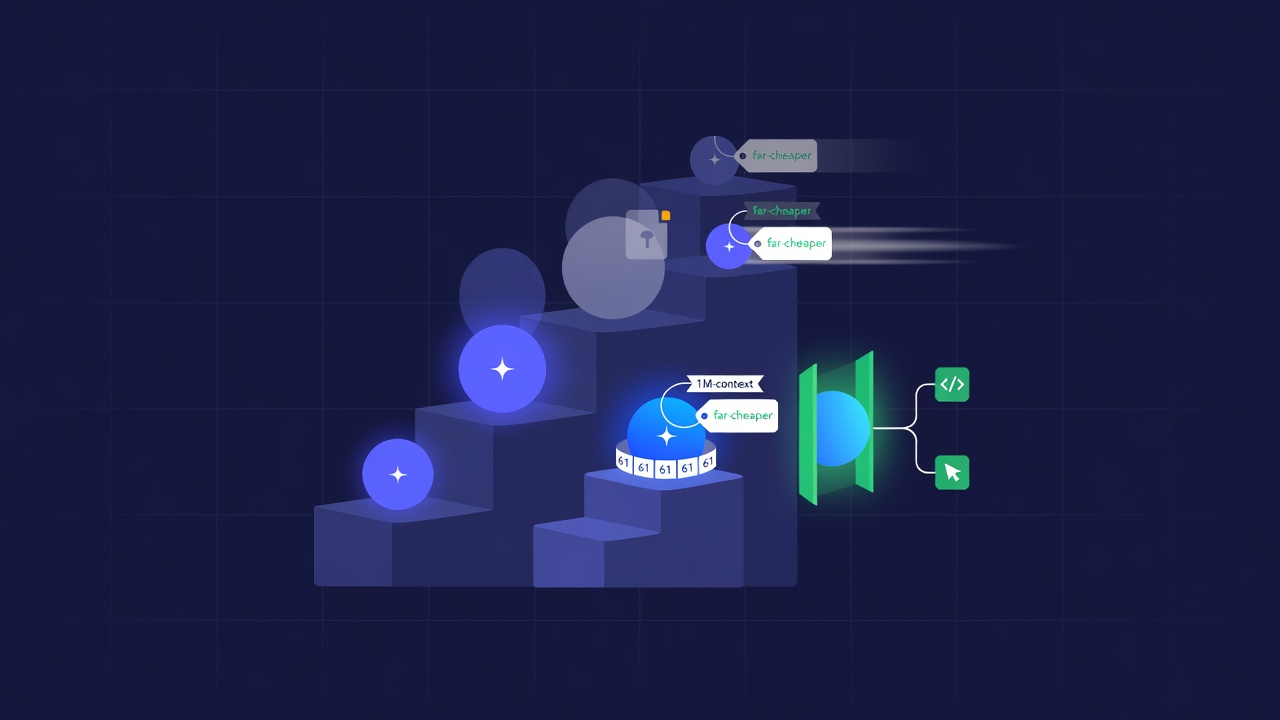
Gemini 4 Neon Is the First High-End Gemini 4 You Can Actually Use Today
Quick verdict
Google shipped another Gemini 4 model, and this one you can run today. Gemini 4 Neon slots between Carbon and Hydrogen, costs $3 per million input tokens and $15 per million output, and lands second or third on nearly every independent leaderboard that matters. It is not the smartest model on the chart. Artificial Analysis puts it third on the Intelligence Index, behind GPT-6.2 Astra and Claude Fable 5.2. What it is, is the cheapest path to that level of work: it tops the Coding Agent Index at roughly half the cost of Opus 5.5 and a third the cost of Fable 5.2, and it does a full index task for about $6.44. The bigger shift is that Carbon launched locked to vetted cyber defenders and almost nobody could touch it. Neon shipped day zero in the paid Gemini API, GitHub Copilot, and Cursor. For once the top-of-chart Gemini is something you can actually point at your own work.
What actually shipped
Neon is aimed at the same three jobs as the rest of the Gemini 4 line: software engineering, enterprise knowledge work, and science. Google positions it between Carbon and Hydrogen, so it is the mid-high tier rather than the absolute flagship. The specs Google led with:
- Pricing: $3 per million input tokens, $15 per million output, and $0.15 per million for cached input. That is noticeably below Carbon's list price.
- Context and output: a 1M-token context window, with Vals reporting a 1M max output limit.
- Effort levels: four settings, low, medium, high, and xhigh, so you can trade latency for quality per call.
- Availability: live in the paid Gemini API, AI Studio, Gemini for business, Antigravity, and the Gemini app for Pro and Ultra subscribers. It also launched day zero inside GitHub Copilot and Cursor.
Google's own framing leaned on behavior over raw scores. It cites improved steerability, a number two placement on Agent Arena Steering, and what it calls its lowest fabrication rate yet in internal Antigravity testing. Google also says its own benchmarks have Neon beating Opus 5.5 and GPT-6.2 Sol on 16 of 19 tests. Take a vendor's internal sweep for what it is, but the independent numbers below back up the general shape.
Where it lands against Astra, Opus, and Fable
Three outside labs ran Neon, and they mostly agree: a top-three model on quality, a clear winner on cost. Artificial Analysis put Neon at xhigh at 61 on the Intelligence Index, third behind GPT-6.2 Astra at max and Claude Fable 5.2 at max. The cost line is where it separates from the pack:
| Model | Index / rank | Cost per task | Notes |
|---|---|---|---|
| Gemini 4 Neon (xhigh) | 61, #3 Intelligence Index | $6.44 | ~110 tokens/s, ~21 min/run |
| Gemini 4 Carbon | — | ~$7.76 | Neon is ~17% cheaper per task |
| Claude Opus 5.5 | Coding Agent Index tie | $12.61 | Neon matches its coding score |
| Claude Fable 5.2 | #1 Vals Index, 71.3% | $15.47 | Neon #2 at 70.9% |
The coding result is the one worth sitting with. On the Coding Agent Index, Neon scores 59 in Google's Antigravity CLI, level with both Fable 5.2 and Opus 5.5, but it does that work for $6.86 a task against $12.61 for Opus and $15.47 for Fable. That is the same quality tier for roughly half to a third of the bill. Artificial Analysis also clocked Neon at about 110 tokens per second, nearly double Carbon's 57, so it is faster as well as cheaper, though it burns about 15% more output tokens per task doing it.
The rest of the leaderboards tell the same story. On the Vals Index, Neon placed second at 70.9%, four tenths of a point behind Fable 5.2 at under half the cost per task, and it took first on both Vals' Finance and Legal indexes. On Agent Arena it sits second with 1336 points at a $2.82 median cost per task, ahead of Opus 5.5 at 53% lower cost, and Google now holds the top three spots in Text Arena. Cursor's own CursorBench 4.1 put Neon at 63.7% on default effort, up from 57.3% for Hydrogen.
The caveats that keep it honest
Neon is not a clean sweep, and a couple of numbers deserve an asterisk. Its reported 39% on SWE-sweep leans heavily on the harness it runs in. Kilian Lieret measured it at just 12.8% with mini-swe-agent, which is a reminder that a coding score is as much about the scaffolding around the model as the model itself. Several of Neon's best coding numbers were measured inside Google's own Antigravity CLI, the same caveat that followed Carbon, so how it behaves in other harnesses is the thing to watch as outside teams run it.
There were operational bumps too. An early-access tester's Antigravity logs showed 762 tool calls and a 93% cache hit rate on one run, which is the good kind of detail, but the same tester also counted 57 "no capacity" errors before launch. A model you can technically access is not the same as a model that answers every request under load. On the plus side, the hands-on reaction was warmer than Google usually gets. Theo, who is a frequent Gemini critic, called Neon "so good" and said it "should have been named Gemini 5."
One pattern is hard to miss across the whole Gemini 4 run. The gaps between releases keep shrinking: 28 days from Argon to Carbon, 15 to Hydrogen, and 6 to Neon. Google is shipping high-tier models faster than most teams can finish evaluating the last one, which is great for the chart and exhausting if you are trying to standardize on a single model.
What it means if you pay for AI
This is the first Gemini 4 at this tier you can act on the same day it shipped, so the takeaway is concrete for once. If you are doing agentic coding or long-horizon knowledge work, Neon gets you Opus-5.5-level results on the Coding Agent Index for roughly half the cost per task, and it is already wired into Copilot and Cursor. That is a real lever on your monthly AI spend, not a benchmark you have to wait months to use.
The deeper lesson is the one this whole Gemini 4 cadence keeps teaching. The frontier now rotates every week or two, and each model wins on a different axis. Astra and Fable lead on raw intelligence, Neon leads on cost per task, Opus leads on certain coding harnesses. No single subscription captures that, because the best model for your next task flips before your billing cycle does. For how the three labs stack up overall, see our OpenAI vs Anthropic vs Google breakdown, and our Gemini 4 Carbon launch piece for the gated model Neon just made look expensive. The sane setup is to route each job to whatever model is currently cheapest for the quality you need, instead of committing to one lab's pricing, which is the whole point of an AI aggregator. Neon's real contribution is not that it is the smartest model. It is that it dragged the price of top-three work down and, unlike Carbon, actually let you use it.
Video: Gemini 4 Neon tested
A hands-on walkthrough of what Neon does well, where the benchmark card oversells, and how it holds up on real coding tasks.
FAQ
Can I use Gemini 4 Neon right now?
Yes. Unlike Gemini 4 Carbon, which launched gated to vetted cyber defenders, Neon shipped into the paid Gemini API, AI Studio, Gemini for business, Antigravity, and the Gemini app for Pro and Ultra subscribers. It also went live day zero inside GitHub Copilot and Cursor.
How much does Gemini 4 Neon cost?
$3 per million input tokens, $15 per million output, and $0.15 per million for cached input. On the Coding Agent Index a full task runs about $6.86, against $12.61 for Claude Opus 5.5 and $15.47 for Claude Fable 5.2 at the same score. On Artificial Analysis's Intelligence Index a task costs about $6.44, roughly 17% below Carbon.
Is Gemini 4 Neon better than Opus 5.5 or GPT-6.2 Astra?
On raw intelligence, no. Artificial Analysis ranks it third on the Intelligence Index, behind GPT-6.2 Astra and Claude Fable 5.2. On coding it ties Opus 5.5 and Fable 5.2 on the Coding Agent Index while costing far less, and it leads Vals' Finance and Legal indexes. It wins on cost per task, not peak capability. See our OpenAI vs Anthropic vs Google guide for the full picture.
Why does Neon cost less than Carbon if it is newer?
Neon is positioned a tier below Carbon in the Gemini 4 lineup, between Carbon and Hydrogen, so it is tuned for low-latency agentic work rather than the absolute top of the chart. Its $3/$15 pricing and faster 110 tokens per second output make it cheaper per task even though it scores a hair lower on pure intelligence.
Sources
- Sundar Pichai - Gemini 4 Neon rollout announcement
- Google DeepMind - introducing Gemini 4 Neon
- Koray Kavukcuoglu - steerability and fabrication-rate claims
- Google AI Studio - pricing and four effort levels
- Artificial Analysis - Neon #3 on Intelligence Index, cost and speed
- Vals - Neon #2 on the Vals Index, #1 on Finance and Legal
- Arena - Neon #2 on Agent Arena, Google holds top three Text Arena spots
- Cursor - day-zero support and CursorBench 4.1 score
- GitHub - Neon available day zero in Copilot
- The Rundown - Google's internal 16-of-19 benchmark claim
- Kilian Lieret - SWE-sweep score depends on the harness
- kimmonismus - Antigravity logs, cache hits, and no-capacity errors
- Theo - "so good," should have been Gemini 5
- r/singularity - Gemini 4 Neon launch discussion
Further reading
Try all the models mentioned in this article
Admix gives you GPT-5, Claude, Gemini, and 300+ AI models in one app. Compare responses side by side. Try it for 7 days for $1.99.
Try Admix for $1.99