OpenAI Open-Sourced a Codex Security Scanner and Gave 100,000 Researchers Free Frontier Access
Quick verdict
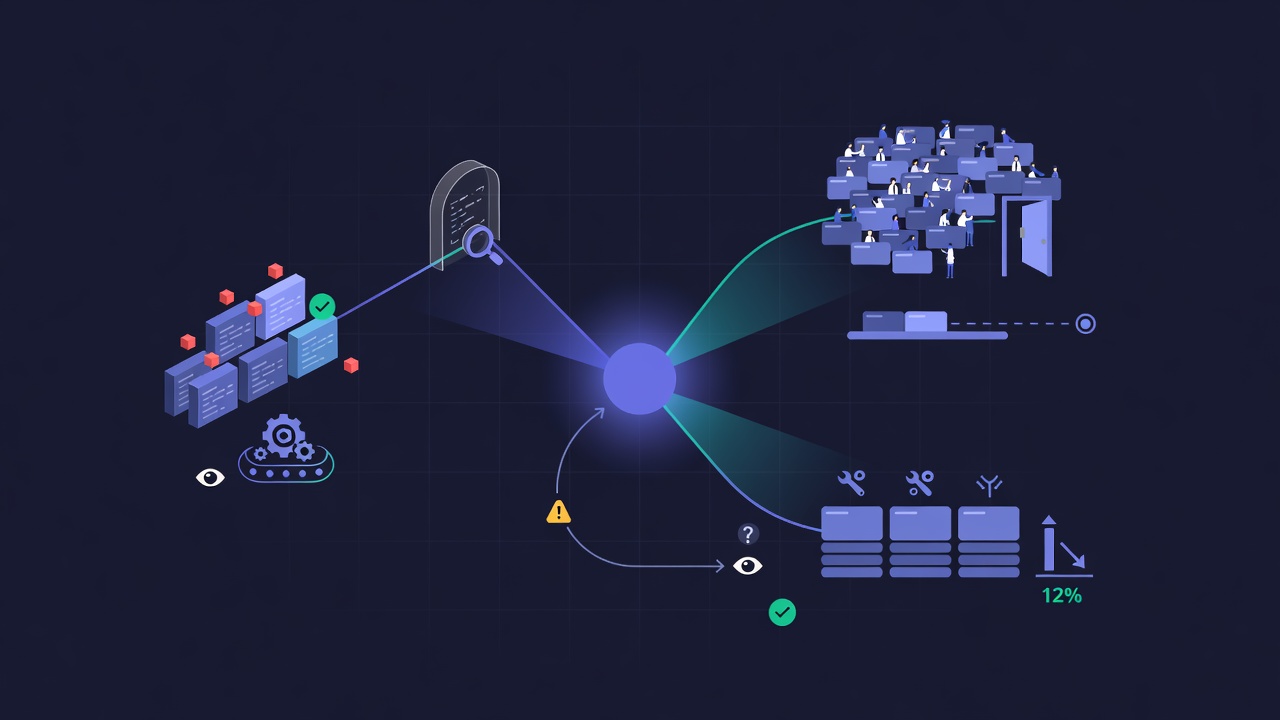
OpenAI had a quiet day on paper and a busy one for developers. It open-sourced the Codex Security CLI, a scanner that reads your repo and CI/CD pipeline, tracks findings across runs, and checks whether fixes actually stuck. It opened a program to give researchers free access to frontier models, starting at 10,000 people and aiming for 100,000 by 2027. And it said its own model, GPT-5.6 Sol, rewrote parts of OpenAI's serving stack to cut costs 20%. None of these is a flashy new chatbot. All three are about the same thing: pushing OpenAI's models deeper into the plumbing where real work happens.
What actually shipped
The clearest release is the Codex Security CLI. It is an open-source repository scanner you can install and point at a codebase or wire into a pipeline. It scans for issues, keeps a record of what it found across runs so you can see whether a problem is new or lingering, verifies that a fix closed the finding, and drops into CI/CD so the check runs on every push instead of during an occasional audit. By engagement it was the standout launch of the day, which tracks: a free tool that does something concrete for security and dev teams tends to travel further than another benchmark chart.
The second piece is the researcher program. OpenAI is handing free frontier access, including the GPT-5.6 family, to academics with business-grade privacy settings and up to four collaborators per workspace. It starts at 10,000 researchers and is meant to reach 100,000 by 2027. Sebastien Bubeck framed the reasoning as scientific acceleration happening through researchers directly, not only inside the lab. Read commercially, it is also a distribution move: get a generation of scientists building on your models before they build on anyone else's.
The third is the most interesting and the hardest to check. OpenAI says GPT-5.6 Sol was applied to its own production serving after deployment and found real wins: about 20% lower serving costs through GPU kernel improvements, and 15%-plus better token-generation efficiency from work on speculative decoding. Greg Brockman and others amplified it as a concrete case of a model optimizing the infrastructure that runs models, not just writing a demo app.
Why it matters if you write code
Security scanning has usually meant a paid product, a periodic audit, or a pile of linters nobody keeps current. An open-source CLI that lives in your pipeline and remembers findings across runs lowers the bar to almost nothing. You can add it to a personal project or a small team's repo without a procurement conversation. That is the same reason free coding agents have spread so fast, and it is worth reading this next to our roundup of the best AI coding agents and the best free AI coding agents, because the scanner slots into the workflow those tools already run.
The self-optimizing infra story matters for a quieter reason: price. If a lab can point its own model at its serving stack and take 20% off the cost of running it, some of that eventually shows up in what you pay per token. It does not always, and margins can absorb the savings instead. But the mechanism is now a demonstrated datapoint rather than a slide, which is the kind of thing that shapes where model pricing goes over the next year.
The Codex loop is starting to close
Put the three announcements side by side and a pattern shows up. Codex writes and reviews code, a Codex-derived tool now scans code for security problems, and a Sol model tuned the infrastructure that serves Codex itself. On the same day, Cline reported that a rival open model spent 17 hours recursively improving its own agent harness, lifting a terminal benchmark from 77.5% to 88.8% while cutting the run cost from $79 to about $50. Different companies, same direction: models are moving from doing tasks to improving the systems that do tasks.
That is genuinely useful and also the part to watch closely. A model that edits its own serving kernels or grades its own security findings runs a much shorter feedback loop than a human review, which is the whole reason to keep a person on the diff. Convenient and unsupervised are not the same setting.
The part worth being skeptical about
The 20% number is OpenAI measuring OpenAI, on OpenAI's own stack, with no outside replication. It may be entirely real and still not generalize past their specific hardware and workload. The scanner is more checkable, since you can run it yourself, but "finds security issues" covers everything from a genuine catch to noisy false positives that bury the real ones. And the academic program's headline is 100,000 researchers by 2027, which is a target, not a rollout. Ten thousand seats today is the fact; the rest is a roadmap.
The honest read is that this was a strong day for practical tooling and a weak day for verification. The Codex Security CLI is the piece you can actually pick up and test, which is exactly why it, and not the cost-savings tweet, was the release that spread.
Why it matters
OpenAI spent the day pushing its models into three places they were not before: your security pipeline, the academic lab, and its own serving infrastructure. For anyone who codes, the near-term takeaway is a free scanner worth trying and a reminder to keep a human on anything a model changes without asking. For the market, the self-optimization result is the one to file away, because a lab that can cheapen its own inference is a lab that can move on price when it wants to. If you are trying to keep AI coding costs sane while these tools multiply, our guide to cutting AI coding agent costs with model routing is a good next stop.
Video: OpenAI Codex in a real workflow
A hands-on look at how Codex fits into day-to-day coding and where the security and CLI pieces slot in.
FAQ
What is the Codex Security CLI?
It is an open-source command-line scanner from OpenAI that reads a repository or CI/CD pipeline, tracks security findings across runs, verifies that fixes closed them, and can run automatically on every push instead of during an occasional audit.
Is it free to use?
The scanner itself is open source, so you can install and run it without a paid plan. Running frontier models against your code for deeper analysis is a separate question of whatever model access you already pay for.
How do researchers get free frontier access?
OpenAI launched a program giving academics free access to frontier models, including the GPT-5.6 family, with business-grade privacy and up to four collaborators per workspace. It starts at 10,000 researchers and is meant to expand to 100,000 by 2027.
Did a model really cut OpenAI's serving costs by 20%?
OpenAI says GPT-5.6 Sol optimized its production serving stack after deployment for roughly 20% lower cost and 15%-plus better token efficiency. It is OpenAI measuring its own stack with no outside replication yet, so treat it as a promising internal result rather than a proven benchmark.
Should I let an AI tool auto-fix security findings?
Use it to surface and triage, keep a person on the actual fix. A scanner that both finds and verifies its own fixes is a fast loop, and fast is exactly when a human review is worth keeping.
Sources
- @OpenAI - open-sourcing the Codex Security CLI for repos and CI/CD
- @OpenAI - Codex Security CLI install and docs
- @OpenAI - free frontier access for academic researchers
- @SebastienBubeck - on accelerating science through researchers directly
- @OpenAI - GPT-5.6 Sol optimizing production serving for 20% lower cost
- @gdb - on a model improving the infrastructure that serves models
- @cline - 17 hours of recursive harness self-improvement, 77.5% to 88.8%
Further reading
Try all the models mentioned in this article
Admix gives you GPT-5, Claude, Gemini, and 350+ AI models in one app. Compare responses side by side. Free to start.
Start free on Admix